PRAHRAN STORE NOW OPEN · THU–MON · 10AM–6PM

Makoto Kurosaki  |  SKU: MKT-SMDRZK-SS-GY210

Makoto Kurosaki Samidorizuki SGStrix Gyuto 210mm

Regular price $399.95

Sold out right now

Leave your email and we’ll send one message the moment it’s back in stock.

One email, no marketing. Privacy policy.

Availability

  • St Peters, NSW —
    2 Bishop St, Unit 2, St Peters NSW 2044
  • Crows Nest, NSW —
    107 West St, Shop 1, Crows Nest NSW 2065
    Pickup only
  • Prahran, VIC —
    180 Commercial Road, Shop 1, Prahran VIC 3181
    Pickup only
Detailed Specifications
Line Makoto Kurosaki Samidorizuki SGStrix
Profile Gyuto / Chef's knife
Bevel Type Double Bevel
Weight 170 g | 6.0 oz
Edge Length 215 mm | 8 15/32″
Heel Height 47 mm | 1 27/32″
Width @ Heel 2.1 mm | 5/64″
Width @ Mid 2.0 mm | 5/64″
Width @ 1cm from Tip 1.3 mm | 3/64″
Steel SPG STRIX | Powdered | Stainless
Blade Construction Sanmai - Stainless Clad
Hardness (HRC) 63 - 65
Surface Finish To Be Added
Handle Special Handle
Region Takefu
Best for
  • Enthusiasts
  • Pro chefs
  • Household
  • Free shipping for knives over AU$200 Australia wide.
  • World-wide shipping via DHL Express, 3 to 5 days.


The Samidorizuki line carries SPG STRIX, a powdered stainless steel from Takefu Special Steel hardened to 63 to 65 HRC. It is built on a strengthened metallic base, so despite the high hardness it sharpens with feedback closer to a carbon steel than a typical powder stainless.

Each blade is a double bevel sanmai build, on an octagonal stabilised birch handle. The gyuto weighs 170 g with a 215 mm edge and a spine that tapers from 2.1 mm at the heel to 1.3 mm near the tip; the compact 170 mm santoku is 148 g, and the 135 mm petty handles the peeling and detail work at 81 g.

At 63 to 65 HRC the edge holds up well, and the steel is designed so it sharpens with the feedback of a carbon steel on your usual stones. For cooks who want high hardness without the fuss of carbon steel, this series threads that needle well.

Video Review

Pros Cons
  • Excellent performance
  • Ideal for the household
  • Great for professionals
Care Instruction
  1. Don't cut hard things! Japanese knives are brittle so bone hacking is a NO NO!
  2. Wash with neutral detergent after use, and wipe dry;
  3. Please don't wash knife with dishwasher, it will damage the wood handle;
  4. Be careful not to leave the knife close to a heat source for a long time;
  5. It is a lot more dangerous to cut with a blunt knife than a sharp knife!
  6. It is best to sharpen a Japanese knife regularly on a waterstone.

Makoto Kurosaki

Makoto Kurosaki (黒崎真) is a professional sharpener based at Takefu Knife Village in Echizen, Fukui, where he runs his own sharpening workshop, Style K, opened in 2018. He is the older brother of blacksmith Yu Kurosaki, and his work shows a family eye for clean, crisp knife design, but his own role is the one behind the edge: taking forged blades and grinding and sharpening them into knives that actually cut. His Kaen line, with its hexagonal tsuchime patterns and VG10/VG2 coreless damascus, pairs that clean look with thin, light geometry.

In 2020 he was certified a Dento Kogeishi (traditional craftsman), and his recent lines use modern steels such as Takefu's SPG Strix powdered stainless, hardened to 63-65 HRC while keeping a carbon-like sharpening feel. The workshop is now organised as Echizen Kurosaki K.K. (越前くろさき). He is a sharpener (togishi), not a blacksmith, so his craft is the finishing that turns a forged blank into a working knife.

“The sharpener's craft: clean, crisp lines and near-laser grinds from Echizen.”

Est. 2018 | 平成30年
Known for Clean, crisp knife lines and thin, high-performance grinds; work in SPG Strix powder stainless and coreless VG10/VG2 damascus.
Website takefu-knifevillage.jp Read more about Makoto Kurosaki
Makoto Kurosaki — Takefu
Open in Maps app
Tip: add map_place_id for best accuracy.

Knife details

Frequently asked questions

Gyuto or santoku - which should I choose?

Both are all-purpose Japanese knives, and for most home cooks either will handle the bulk of daily prep. The choice comes down to length, blade shape, and how you like to cut.

A gyuto is the Japanese chef's knife - typically 210 to 240mm with a gently curved edge that lets you rock and slide through cuts as well as chop. The extra length and pointed tip give you reach and versatility, from proteins to large produce.

A santoku is shorter, usually 165 to 180mm, with a flatter profile and a rounded sheep's-foot tip. It rewards a straight up-and-down push cut, feels nimble in smaller hands or tight kitchens, and is the classic Japanese household knife.

Rule of thumb: choose a gyuto if you want one do-everything knife with more reach, or a santoku if you prefer a compact, easy-to-control blade. Plenty of our customers end up owning both.

What is a Gyuto, and what is it used for?

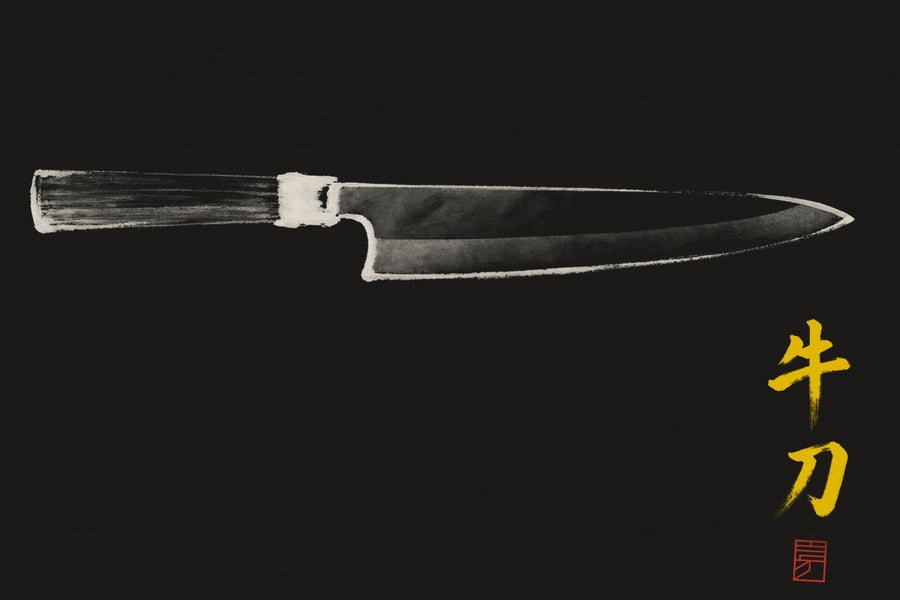
A gyuto is the Japanese chef's knife — a double-bevel general-purpose kitchen knife. The name literally means "beef sword," and it's still a fair job description: you use it to slice meat, chop vegetables, dice aromatics, and break down fish. If you own one good knife, this is the shape it should be.

Versus a typical Western chef's knife, a gyuto is thinner behind the edge, sharpened to a keener angle (roughly 15–18° rather than 20–22°), and usually made from harder steel — often above 60 HRC. That's what makes it slice so cleanly: less crushing, less tearing. The trade-off is a more brittle edge, so it asks to be honed and sharpened more attentively than a soft Western blade.

Blades run from compact 150mm to long 240mm, but for a home kitchen I'd start at 210mm — my sizing FAQ explains why.

What size gyuto should I buy?

In a home kitchen I'd pick a 210mm gyuto. It's the sweet spot: long enough for a full slicing stroke, short enough to stay nimble on a normal cutting board and easy to control while you're still building your technique.

Step up to a 240mm only if you regularly break down large cuts — roasts, whole fish, big vegetable prep. The extra length means longer strokes and fewer passes, but it also means more weight and a bigger board; if the tip is hanging off your bench you're fighting the knife, not cooking with it. If you're mainly doing vegetables and portions, the 240 gives you nothing you'll use.

For a first gyuto, buy a well-made stainless one around 210mm in the low hundreds. Traditional carbon steels (white and blue paper steel) cut and sharpen beautifully, but they rust if you leave them wet — learn one variable at a time. Better steel is step two.

240mm vs 210mm gyuto — which size should I choose?

My call: get the 210mm. I only steer people to a 240mm when they regularly break down roasts, poultry, or whole fish — that's the one job where the extra 30mm genuinely changes how you work.

The trade-off is stroke length versus handling. A 240 slices through a big piece of meat in one or two long draws; a 210 does the same job with more passes but much lighter handling, and fine work — herbs, small dice — stays quick instead of feeling like more knife than you need. The 240 also wants a bigger board, or its tip hangs off the edge and you compensate without noticing.

Longer is not more professional, it's just for bigger food. If you cook like most home cooks, the 210 is the knife you'll reach for every day, and choosing it is a decision, not a compromise.

Japanese vs German kitchen knives — which should I buy?

If you want the sharpest possible edge and don't mind caring for a harder, more brittle blade, buy Japanese; if you want a tougher, more forgiving knife that can take abuse and be honed casually, buy German. Japanese knives, like the gyuto, are ground to a much sharper edge angle, typically 15 to 18 degrees compared to 20 to 22 degrees on a western chef's knife, and use harder steel that can exceed 60 HRC, which is why they cut with such precision but also chip more easily. German knives are softer and more ductile, so they resist chipping and bend rather than break, but they won't hold that razor-sharp edge as long.

A Japanese knife is not the right choice if you regularly cut through bones, frozen food, or hard squash, or if you're used to rocking the blade hard on a cutting board, that lateral stress and impact can chip the edge. German knives are the better everyday beater for heavy prep, but you'll trade away the effortless slicing and fine edge retention that make Japanese steel so satisfying.

The gyuto, literally "beef knife," is the Japanese take on a French chef's knife, with a flatter profile that suits push-cutting and slicing. That acute blade geometry is only possible because of the harder steel used, a typical western knife at 20 to 22 degrees would roll or dull quickly at 15 to 18 degrees, whereas the harder Japanese steel holds that finer edge. That's the core trade-off: hardness buys sharpness and edge retention, but it also makes the blade more brittle, so you need a gentler technique and a wooden or plastic board. For more on how these knives are built and what to look for, see the Knives and Stones Education Centre.

You May Also Like