


Yoshikazu Ikeda White 3 Honyaki Yanagiba 300mm with Wavy Hamon, Heart-shaped Ebony Handle
Yoshikazu Ikeda White 3 Honyaki Yanagiba 300mm with Wavy Hamon, Heart-shaped Ebony Handle is backordered and will ship as soon as it is back in stock.
Sold out right now
Leave your email and we’ll send one message the moment it’s back in stock.
One email, no marketing. Privacy policy.
We match the item price, not shipping, of in-stock products from reputable specialist knife retailers. Clearance and pre-owned items excluded. Each request is checked by our team.
Availability
Delivery unavailable for this item. Available for in-store pickup only.
-
St Peters, NSW —2 Bishop St, Unit 2, St Peters NSW 2044
-
Crows Nest, NSW —107 West St, Shop 1, Crows Nest NSW 2065Pickup only
-
Prahran, VIC —180 Commercial Road, Shop 1, Prahran VIC 3181Pickup only
Goes well with
Detailed Specifications
| Line | Yoshikazu Ikeda Honyaki |
| Profile | Yanagiba / Sashimi knife |
| Bevel Type | Single Bevel |
| Weight | 289 g 10.19 oz |
| Edge Length | 296 mm .11.65 inch |
| Heel Height | 35 mm .1.38 inch |
| Width @ Spine | 4.4 mm 0.17 inch |
| Width @ Mid | 3.8 mm 0.15 inch |
| Width @ 1cm from Tip | 1.1 mm 0.04 inch |
| Steel | White 3 / Shirogami #3 | Carbon |
| Blade Construction | Honyaki |
| Maker's hardening hardness | 60 HRC or more |
| Surface Finish | Mirror Polish |
| Handle | Heart-shaped Ebony Handle |
| Region | Sakai |
| Best for |
|

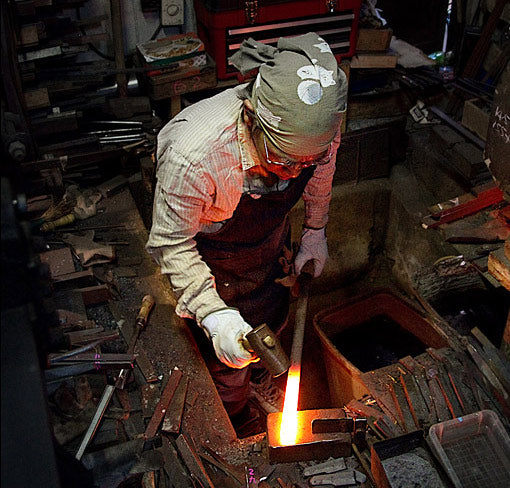
Yoshikazu Ikeda is one of Sakai’s most respected veteran blacksmiths, particularly well known for his work with Honyaki — a demanding traditional construction that requires exceptional control during forging and heat treatment.
This 300mm Yanagiba is forged from White #3 carbon steel in Honyaki construction, using a single piece of steel rather than the laminated structure found on most traditional Japanese knives. White #3 is a particularly interesting choice for Honyaki, offering a fine, responsive edge while bringing a slightly more forgiving character than the harder White #1 commonly associated with high-end Honyaki blades.
Running along the blade is a beautifully defined wave hamon, created through differential heat treatment and forming an integral part of the blade rather than a decorative surface pattern. Its flowing appearance gives the knife much of its individual character while reflecting the traditional techniques behind its construction.
The long 300mm Yanagiba profile is built for smooth, uninterrupted draw cuts through sashimi and delicate proteins, producing clean surfaces with minimal disturbance to the flesh.
Finished with an ebony handle and marble horn ferrule, the warm natural grain provides a refined contrast to the restrained appearance of the Honyaki blade.
A highly traditional Sakai slicer defined by its White #3 Honyaki construction, expressive wave hamon and the unmistakable character of a hand-forged blade.
- Don't cut hard things! Japanese knives are brittle so bone hacking is a NO NO!
- Wash with neutral detergent after use, and wipe dry;
- Please don't wash knife with dishwasher, it will damage the wood handle;
- Be careful not to leave the knife close to a heat source for a long time;
- It is a lot more dangerous to cut with a blunt knife than a sharp knife!
- It is best to sharpen a Japanese knife regularly on a waterstone.
- Oil the (carbon) knife if storing for an extended period of time to prevent rust.
-

Profile: Yanagiba
Sashimi knife
Slide for more >>
-

Steel: White 3 / Shirogami #3
Manufacturer:
Nature: Carbon
Maker's hardening hardness: 60 HRC or more
<< Slide for more >>
-

Handle Specs
Profile: Heart Shape WA
Material:
<< Slide for more


You May Also Like
-
Exotic: Yoshikazu Ikeda White #3 Honyaki Gyuto 240mm with Fujinami Hamon, Amboyna HandleSale price $1,699.98 Regular price $1,999.95Unit price
-
Exotic: Yoshikazu Ikeda White 1 Mizu-Honyaki Sakimaru Takohiki 270mm, Fujinami Hamon Nenox Style Ebony HandleSale price $3,144.98 Regular price $3,699.95Unit price
-
Exotic: Yoshikazu Ikeda Blue #1 Mizu-Honyaki Yanagiba 300mm / Moribashi Set #1Sale price $3,825.98 Regular price $4,500.00Unit price
-
Exotic: Yoshikazu Ikeda Blue #1 Mizu-Honyaki K-tip Yanagiba 300mm with Blood Groove Pau Rosa SetSale price $3,230.98 Regular price $3,800.00Unit price
-
Yoshihiro Ginsan Yanagiba 360mm w/ Double Fullers and Ebony HandleSale price $1,359.98 Regular price $1,599.95Unit price
-
Sukenari SG2 Honyaki Yanagiba 300mm, Ebony Handle Brass FerruleSale price $2,039.98 Regular price $2,399.95Unit price
-
Sukenari VG10 Damascus Yanagiba 330mm, Ebony Three Spacer HandleSale price $1,104.98 Regular price $1,299.95Unit price
-
Sukenari HAP40 Mirror Polished Yanagiba 330 mm, Ebony Brass HandleSale price $924.98 Regular price $1,088.00Unit price
