


Exotic: Yoshikazu Ikeda White #3 Honyaki Gyuto 240mm with Fujinami Hamon, Amboyna Handle
Exotic: Yoshikazu Ikeda White #3 Honyaki Gyuto 240mm with Fujinami Hamon, Amboyna Handle is backordered and will ship as soon as it is back in stock.
Sold out right now
Leave your email and we’ll send one message the moment it’s back in stock.
One email, no marketing. Privacy policy.
We match the item price, not shipping, of in-stock products from reputable specialist knife retailers. Clearance and pre-owned items excluded. Each request is checked by our team.
Availability
Delivery unavailable for this item. Available for in-store pickup only.
-
St Peters, NSW —2 Bishop St, Unit 2, St Peters NSW 2044
-
Crows Nest, NSW —107 West St, Shop 1, Crows Nest NSW 2065Pickup only
-
Prahran, VIC —180 Commercial Road, Shop 1, Prahran VIC 3181Pickup only
Detailed Specifications
| Line | Yoshikazu Ikeda Honyaki |
| Profile | Gyuto / Chef's knife |
| Bevel Type | Double Bevel |
| Weight | 203 g 7.16 oz |
| Edge Length | 230 mm .9.06 inch |
| Heel Height | 49 mm .1.93 inch |
| Width @ Spine | 3.5 mm 0.14 inch |
| Width @ Mid | 2.5 mm 0.1 inch |
| Width @ 1cm from Tip | 0.8 mm 0.03 inch |
| Steel | White 3 / Shirogami #3 | Carbon |
| Blade Construction | Honyaki |
| Maker's hardening hardness | 60 HRC or more |
| Surface Finish | Mirror Polish |
| Handle | Amboyna Octagonal Horn |
| Region | Sakai |
| Best for |
|

There is something particularly appealing about a Honyaki knife that doesn't rely on a full mirror polish to show off its hamon. This exceptional 240mm Gyuto, forged by the renowned Sakai blacksmith Yoshikazu Ikeda (池田美和), takes a more subtle and traditional approach. Featuring an elaborate Fujinami hamon and a special natural stone finish known as Oboro-ukashi (朧浮かし), executed by Nori Igarashi (五十嵐 宣), the blade displays a beautiful contrast between the soft, misty hamon and the clean Migaki finish of the surrounding steel. The result is a rather understated elegance that I find just as captivating as the highly reflective mirror-polished Honyaki knives.
The blade is forged from Shirogami #3 (White 3) carbon steel using traditional Honyaki construction. Unlike the more commonly encountered White 1 and White 2, White 3 contains a lower percentage of carbon, allowing it to achieve a somewhat more forgiving balance of hardness and toughness. Although it may not reach the extreme hardness or edge retention of its higher-carbon counterparts, White 3 is relatively approachable to sharpen and still capable of taking an exceptionally fine edge. In a Honyaki construction, where the blade is differentially hardened from a single piece of steel rather than laminated with softer cladding, this more forgiving character can be particularly desirable for a knife intended to see actual kitchen use.
What really sets this piece apart is the exceptional finishing work by Nori Igarashi (五十嵐 宣), a highly skilled Sakai sharpener. The blade features a Fujinami (富士波, Mount Fuji and Waves) hamon, with the distinctive mountain silhouette rising above the flowing waves along the blade. Rather than polishing the entire surface to a uniform mirror finish, Igarashi has carefully hand-finished the blade using natural Japanese whetstones, employing a technique known as Oboro-ukashi (朧浮かし). The term describes the soft, hazy appearance of the hamon, which seems to emerge or float from the surrounding steel. The natural stone polishing brings out the hardened structure in a delicate, misty white, contrasting beautifully with the smooth, reflective Migaki finish of the blade. Unlike the sharp, high-contrast appearance of a mirror-polished hamon, Oboro-ukashi creates a much softer and more atmospheric effect, allowing the Fujinami pattern to reveal itself gradually as light moves across the surface. It is a remarkably subtle finish, and one that requires considerable skill and patience to achieve consistently.
Being a 240mm Gyuto, this knife is also a practical and versatile kitchen tool, suitable for everything from vegetable preparation to slicing proteins. However, as with any Honyaki, it requires a level of care and sharpening experience beyond that of a conventional laminated Japanese knife. The reactive carbon steel needs to be cleaned and dried promptly, and the delicate natural stone finish deserves particular attention to preserve its original appearance. We have paired the blade with a beautiful Amboyna wood handle, whose rich colour and intricate grain provide a warm contrast to the restrained elegance of the blade, adding another layer of individuality to this already remarkable piece.
For me, the real attraction of this knife is how the skills of two exceptional craftsmen complement each other. Ikeda's forging and differential hardening create the foundation for the beautiful Fujinami hamon, while Igarashi's Oboro-ukashi polishing brings out its character in an entirely different way from conventional mirror finishing. The result is a knife that doesn't immediately overwhelm with brilliance, but instead rewards closer observation, with the misty hamon seemingly floating across the polished steel. Together with the distinctive Amboyna handle, this is a particularly interesting Honyaki for serious collectors and enthusiasts who appreciate the artistic possibilities of traditional Japanese knifemaking.
- Don't cut hard things! Japanese knives are brittle so bone hacking is a NO NO!
- Wash with neutral detergent after use, and wipe dry;
- Please don't wash knife with dishwasher, it will damage the wood handle;
- Be careful not to leave the knife close to a heat source for a long time;
- It is a lot more dangerous to cut with a blunt knife than a sharp knife!
- It is best to sharpen a Japanese knife regularly on a waterstone.
- Oil the (carbon) knife if storing for an extended period of time to prevent rust.

-

Profile: Gyuto
Chef's knife
Slide for more >>
-

Steel: White 3 / Shirogami #3
Manufacturer:
Nature: Carbon
Maker's hardening hardness: 60 HRC or more
<< Slide for more >>
-
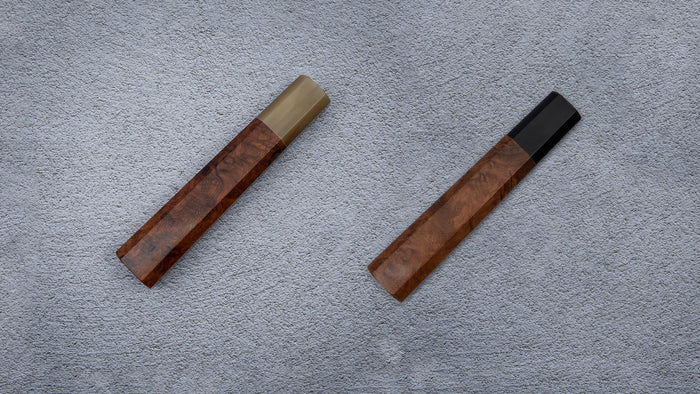
Handle Specs
Profile: Octagonal WA
Material:
<< Slide for more


You May Also Like
-
Yoshikazu Ikeda White 3 Honyaki Yanagiba 300mm with Wavy Hamon, Heart-shaped Ebony HandleSale price $1,869.98 Regular price $2,199.95Unit price
-
Exotic: Yoshikazu Ikeda White 1 Mizu-Honyaki Sakimaru Takohiki 270mm, Fujinami Hamon Nenox Style Ebony HandleSale price $3,144.98 Regular price $3,699.95Unit price
-
Exotic: Yoshikazu Ikeda Blue #1 Mizu-Honyaki Yanagiba 300mm / Moribashi Set #1Sale price $3,825.98 Regular price $4,500.00Unit price
-
Exotic: Yoshikazu Ikeda Blue #1 Mizu-Honyaki K-tip Yanagiba 300mm with Blood Groove Pau Rosa SetSale price $3,230.98 Regular price $3,800.00Unit price
-
Takeshi Saji VG10 Kurozome Black Damascus Gyuto 210mm Ebony Handle Horn FerruleSale price $399.98 Regular price $469.95Unit price
-
Takeshi Saji SG2 Diamond Damascus Gyuto 240mm Ebony HandleSale price $722.98 Regular price $849.95Unit price
-
Takeshi Saji SG2 Diamond Damascus Gyuto 270mm Ebony Handle Horn FerruleSale price $798.98 Regular price $939.95Unit price
-
Tojiro VG10 Supreme 37 Layered Flowing Mist Gyuto 260mm FD-915Sale price $167.99 Regular price $239.95Unit price
