Crows Nest store now open from Friday to Tuesday, in store specials!

Shiro Kamo  |  SKU: SK-KK-SG2BLDM-GY210

Shiro Kamo Kurokumo SG2 Black Damascus Gyuto 210mm Ebony

Regular price $399.95

Add a saya or K&S Knife Roll to receive $20 bundle discount!

Shiro Kamo Kurokumo SG2 Damascus
Gyuto / Chefs Knife
Double Bevel
Weight 181 g | 6.4 oz
Edge Length 215 mm | 8 15/32″
Heel Height 54 mm | 2 1/8″
Width @ Heel 2.6 mm | 7/64″
Width @ Mid 2.0 mm | 5/64″
Width @ 1cm from Tip 0.8 mm | 1/32″
Steel SG2 / R2 | Powdered | Stainless
Blade Construction Sanmai - Stainless Damascus Clad
Hardness (HRC) 62 - 64
Surface Finish Etched
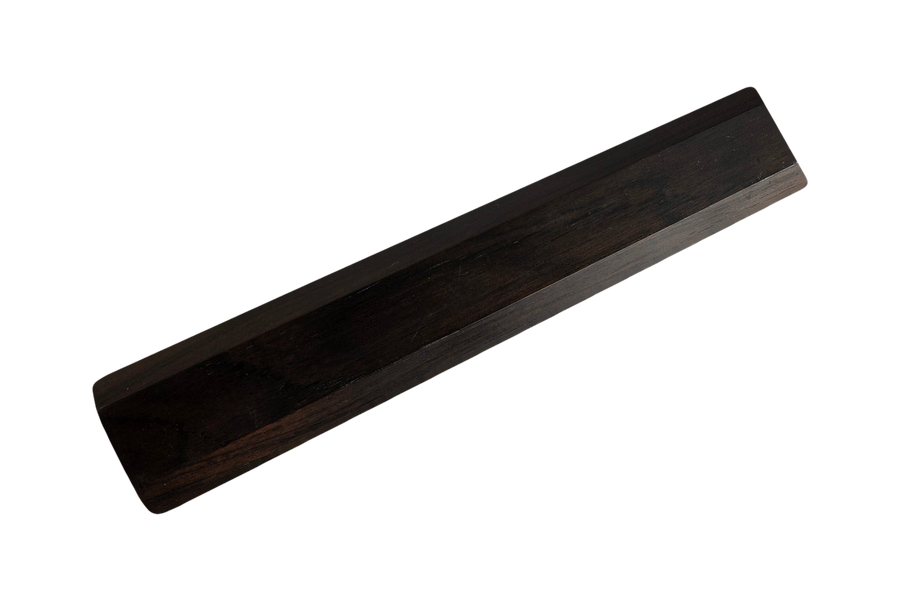
Handle Octagonal Ebony
Region Echizen
Best for
  • Pro chefs
  • Enthusiasts
  • Free shipping for knives over AU$200 Australia wide.
  • World-wide shipping via DHL Express, 3 to 5 days.


Shiro Kamo's SG2 Kurokumo Black Damascus line of kitchen knives is a fusion of outstanding performance and striking design. Made from SG2 powdered steel by Takefu Special Steel, these knives are known for their exceptional hardness and long-lasting edge retention, providing a razor-sharp blade that excels in precision cutting. Whether you’re slicing vegetables or proteins, the superior cutting performance ensures effortless and clean cuts.

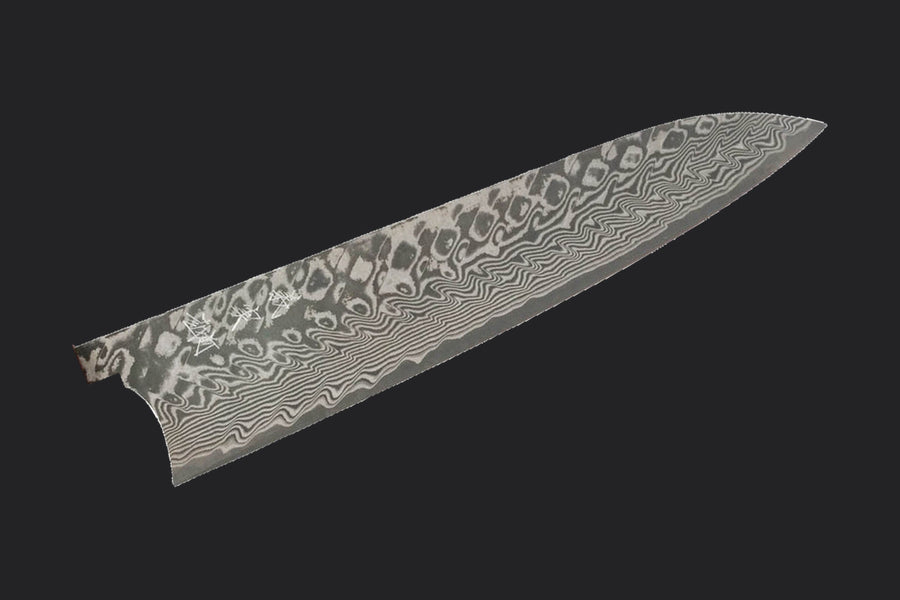
The blade features a breathtaking black damascus pattern, giving it a unique, bold appearance that reflects the meticulous craftsmanship. Complementing the blade is an elegant octagonal ebony handle, providing a comfortable grip and perfect balance. This handle adds sophistication and durability, making the knives not only functional but a pleasure to hold and use.

Pros Cons
  • Excellent performance
  • Great artistic
  • Relatively hard to sharpen
Care Instruction
  1. Don't cut hard things! Japanese knives are brittle so bone hacking is a NO NO!
  2. Wash with neutral detergent after use, and wipe dry;
  3. Please don't wash knife with dishwasher, it will damage the wood handle;
  4. Be careful not to leave the knife close to a heat source for a long time;
  5. It is a lot more dangerous to cut with a blunt knife than a sharp knife!
  6. It is best to sharpen a Japanese knife regularly on a waterstone.

Shiro Kamo

Shiro Kamo — Echizen's Forging Purist

Shiro Kamo, the second generation blade smith of the Kamotou Hamono, is an expert of forging. He only keep feel designs but they are tuned to near perfect. Kamo san's knife is known for the broad profile and extreme thin bevel, paired with high hardness SG2 and Blue Super steel, his blades are some of the best cutters especially for hard and dense vegetables.

It is worth mentioning Kamo san do forge stainless and carbon steel alike, while the SG2 is much hard to deform under forging temperature, he seems to be able to command steel into his desired shape with little effort. His understanding and experience in forging and sharpening lead to incredibly well polished designs, which excels in handling, lightness and cutting smoothness.

Read more

Shiro Kamo, the second generation blade smith of the Kamotou Hamono, is an expert of forging extremely high performance blades. Being a member of the TAKEFU Knife Village, his skill level is top notch in the entire Fukui prefecture.

The most know work done by master Shiro Kamo would be his SG2 Suminagashi series. As one of the few blacksmith in this industry that does hand forging of powder stainless steel, his knife is the thinnest I've ever seen. As stainless steel tend to be much harder to shape at forging temperature, it just says how impressive of a skill that Kamo san possess being about to keep his knife so thin but straight at the same time.

The matching sharpening is also very aggressive, his SG2 has a small convexity but due to the low overall thickness and broad knife profile,the edges are still very thin. The Kurouchi Blue super has a concave grind which goes through tough food with little effort with its extreme thinness. However, these thin blade are still pretty rigid, thanks to the forged taper that thickens the tang. The combination of these features just shows how much understanding that Kamo san has to blade, and he do have the skill to achieve these details with his hammer like it takes no effort.

We found that Shiro Kamo has only few designs that he forge, and that is somewhat remarkable to me. When we are constantly seeking the shiny new things that just come out, we can always count on Kamo san when we need a knife with solid performance. His dedication and focus have lead to a near perfection of what he do, and anyone who picked up his knife and tried will feel the result of years of tuning over one design. If you want a authentically forged knife from Japan, I will definitely check out master Kamo's knives.

“Former chairman of Takefu Knife Village — an Echizen forging master who keeps only a few perfect designs.”

Est. 1955 | 昭和30年
Known for Expert forging, broad profile geometry, few but perfected designs
Read more about Shiro Kamo
Shiro Kamo — Echizen
Profile: Gyuto
Profile

Gyuto

Chefs Knife

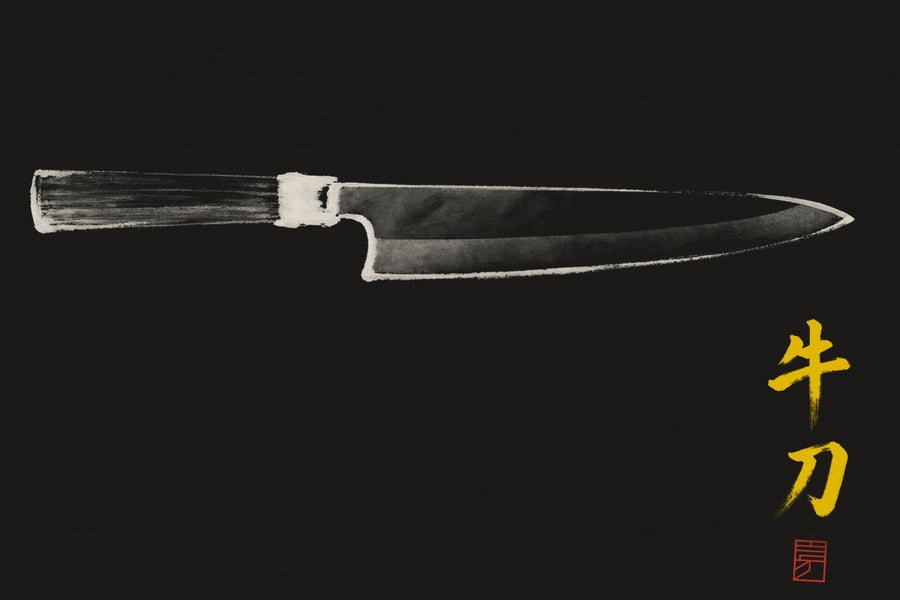
A Japanese chef's knife is known as a gyuto (牛刀 ぎゅうとう) gyūtō), literally meaning 'beef knife'. Its blade resembles a flatter version of a French chef's knife. Japanese cutlery is known for sharpness due to its acute blade geometry, and the hardness of the steel used, sometimes exceeding 60 HRC on the Rockwell Scale A typical western chef's knife may be sharpened to an edge angle of 20-22°, while a Japanese gyuto generally has a sharper edge angle of 15-18° (or even lower), which requires a harder, more brittle grade of steel. In recent years Japanese gyuto have gained in popularity with western chefs.

A modern chef's knife is a multi-purpose knife designed to perform well at many differing kitchen tasks, rather than excelling at any one in particular. It can be used for mincing, slicing, and chopping vegetables, slicing meat, and disjointing large cuts.
Composition

SG2 / R2 Element Composition

Compare with
    SG2 / R2
    14.0% 10.5% 7.0% 3.5% 0
    C Carbon 1.25%
    Primary hardening element. Raises hardness and wear resistance — but too much increases brittleness and corrosion susceptibility. As a reference: German 1.4112 (~0.5%) sits at the low end; VG-10 (~1.0%) is a common mid-range; SG2 (1.25–1.45%) and ZDP-189 (~3.0%) represent high and extreme ends respectively.
    C
    1.25%
    Cr Chromium 14.0%
    Raises corrosion resistance; 13%+ qualifies steel as stainless. Also improves hardenability and wear resistance. In kitchen use, higher chromium levels contribute to a slight drag or sticking sensation when cutting — a trade-off for the rust resistance it provides.
    Cr
    14.0%
    V Vanadium 1.8%
    Forms extremely hard carbides for superior edge retention. Also refines grain structure, improving toughness.
    V
    1.8%
    Mo Molybdenum 2.3%
    Improves hardenability and toughness. Boosts corrosion resistance and helps the steel hold hardness under heat.
    Mo
    2.3%
    Mn Manganese 0.4%
    Aids hardenability and strength. Acts as a deoxidiser during smelting. Excess can reduce toughness.
    Mn
    0.4%
    Si Silicon 0.5%
    Strengthens the steel matrix and acts as a deoxidiser. Improves hardness and resistance to oxidation.
    Si
    0.5%
    P Phosphorus 0.03%
    Impurity from the smelting process. Even small amounts cause brittleness — steelmakers keep this as low as possible.
    P
    0.03%
    S Sulfur 0.03%
    Impurity that reduces toughness and promotes brittleness. Intentionally added only in free-machining steels.
    S
    0.03%
    C — Carbon Cr — Chromium V — Vanadium Mo — Molybdenum Mn — Manganese Si — Silicon P — Phosphorus S — Sulfur
    Hardness 62–64 HRC
    555759616365+
    Steel
    SG2 / R2
    Category
    Stainless
    Process
    Powder Metallurgy (PM)
    Manufacturer
    Takefu Special Steel, Japan 🇯🇵
    Hardness
    62–64 HRC
    Steel

    SG2 / R2

    • Manufacturer
      • Takefu Special Steel, Japan
    • Nature Stainless
    • Hardness62–64 HRC
    SG2, also known as Super Gold 2 or R2 steel, is a high-end powdered tool steel by Takefu Special Steel, known for its excellent edge retention, wear resistance, and ability to achieve a hardness of up to 64 HRC. Identical to Kobelco Steel's R2, it's prized in premium knife making for its fine edge sharpness and durability. The powdered nature ensures uniform carbide distribution, enhancing toughness and reducing chipping risks. SG2/R2 is ideal for those seeking top performance and longevity in their cutting tools.
    Construction: Sanmai - Stainless Damascus Clad
    Construction

    Sanmai - Stainless Damascus Clad

    Sanmai(Three-Piece) is a common construction for double bevel knives where two pieces of softer cladding steel are forgewelded to each side of a harder core steel. The harder but more brittle core steel will form the hard cutting edge after heat treating, and the softer cladding will support the core to increase the overall strength of the blade.

    Damascus Sanmai utilize damascus steel as the cladding material for the Sanmai construction, which adds aesthetic feature to the blade. On the Kitchen knives with stainless core steel, the damascus cladding will be stainless, this means they will also protect the carbon/semi-stainless core from rusting/discolouration.

    The soft cladding enables the thinning process to be a lot easier than a honyaki or monosteel construction. However, when the cladding is made of damascus, whether etched, polished or mirror polished, the thinning process will take a toll on the cladding, meaning the damascus won't look the same as when it was taken out of the box.

    Finish: Etched
    Finish

    Etched

    The etching process starts with the knife being thoroughly cleaned to remove any oils or residues. A protective mask may be applied to the areas not intended to be etched. The blade is then submerged in an acidic solution, such as ferric chloride, which reacts with the different layers of steel at varying rates. This creates a layer of dark oxide on the surface of the blade where the thickness of the oxide varies according to the reactiveness of the steel. After etching, the knife is neutralized in a baking soda solution, rinsed, and dried. The final step involves polishing the blade to highlight the etched design, enhancing both the knife's beauty and showcasing the craftsmanship of its maker.

    Handle
    Handle

    Handle Specs

    • Profile Octagonal WA
    • Material
      • Ebony

    This handle, crafted from a single piece of ebony, exemplifies minimalist elegance and functional design. Its unique octagonal shape, featuring a subtle taper, offers a comfortable grip and a visually appealing geometric profile. The ebony wood, known for its deep, rich color and durability, has been meticulously milled from a single block, ensuring a seamless construction that highlights the wood's natural beauty and grain. The handle's surface has been highly polished, achieving a glossy finish that not only enhances the ebony's luxurious dark hue but also provides a smooth, tactile experience for the user. This design choice reflects a minimalist approach, focusing on simplicity, quality, and usability. The combination of the octagonal shape with the taper adds a modern twist to the classic material, making it a standout piece that blends traditional craftsmanship with contemporary aesthetics.

    1 / 5

    You May Also Like