PRAHRAN STORE NOW OPEN · THU–MON · 10AM–6PM

Mazaki  |  SKU: MAZA_W2MK_DE180

Mazaki White 2 Migaki Deba 180mm

Sale price $399.98 Regular price $469.95

IMPORTANT: Carbon steel knives can rust or patina quickly if not cared for properly. They require regular cleaning, drying, and oiling. If you are unfamiliar with carbon steel maintenance, we recommend choosing a stainless steel option instead.

In Stock Now

Availability

  • St Peters, NSW —
    2 Bishop St, Unit 2, St Peters NSW 2044
  • Crows Nest, NSW —
    107 West St, Shop 1, Crows Nest NSW 2065
    Pickup only
  • Prahran, VIC —
    180 Commercial Road, Shop 1, Prahran VIC 3181
    Pickup only

Goes well with

Detailed Specifications
Line Mazaki White 2 Migaki
Profile Deba / Japanese fish knife
Bevel Type Single Bevel
Weight 284 g | 10.0 oz
Edge Length 185 mm | 7 9/32″
Heel Height 56 mm | 2 13/64″
Width @ Heel 7.4 mm | 19/64″
Width @ Mid 5.3 mm | 13/64″
Width @ 1cm from Tip 2.0 mm | 5/64″
Steel White 2 / Shirogami #2 | Carbon
Blade Construction Sanmai - Soft Iron Clad
Typical hardness 60 to 64 HRC
Surface Finish Migaki
Handle Ho Wood Octagonal
Region Sanjo
Best for
  • Enthusiasts

Free shipping for knives over AU$200 Australia wide.

World-wide shipping via DHL Express, 3 to 6 days (not available in the UK).


Mazaki is one of those independent Sanjo makers who built a following fast, and it's not hard to see why once you pick up one of his knives. The White 2 Migaki line is a good example of what makes his work stand out — it combines a profile and geometry that feel genuinely considered with a level of hand finishing that punches well above what the price might suggest.

The blade profile is broad with a generous heel height and a wide tip, which makes it particularly well suited to dicing and producing consistent thin slices in one committed push. What really defines the handling though is the spine taper — Mazaki keeps the neck near the handle notably thick even by Sanjo standards, then tapers it aggressively down to around 2mm at the tip. This gives the knife an unusual combination of a stiff, confident spine near the handle and a featherlight, responsive tip, which translates into a blade that feels precise and easy to direct despite its size.

The bevel is hand finished to a slightly convex shape with an organic Kasumi polish, and the geometry behind it is worth understanding. The blade is forged thicker near the Shinogi line and combines this with a slightly concave Hira — this creates a more pronounced change in angle at the Shinogi line, which in turn strengthens the food release effect as the slice reaches that transition. The result is a knife that cuts smoothly and releases cleanly without needing to be laser-thin to do it. The Migaki finish on the cladding is hand brushed to follow the irregular geometry of the blade, giving the surface an organic, flowing character rather than the uniform look of a machine-finished knife.

The core steel is White 2 (Shirogami #2), encased in soft iron cladding — which means the entire blade requires careful maintenance to prevent rust, and the steel will need more frequent sharpening than Blue 2 and more attention than stainless alternatives. That said, White 2 rewards the effort with an edge that bites cleanly and sharpens back up with minimal fuss on a whetstone. Priced competitively against big Echizen names and more affordable than Yoshikane while offering a smoother cut, the Mazaki White 2 Migaki is a compelling option for enthusiasts who want a genuinely handcrafted knife with real character and performance to match.

Pros Cons
  • Excellent performance
  • Workhorse grind
  • Great OOTB
  • Need extra care
  • Prone to rust
  • Relatively hard to sharpen
Care Instruction
  1. Don't cut hard things! Japanese knives are brittle so bone hacking is a NO NO!
  2. Wash with neutral detergent after use, and wipe dry;
  3. Please don't wash knife with dishwasher, it will damage the wood handle;
  4. Be careful not to leave the knife close to a heat source for a long time;
  5. It is a lot more dangerous to cut with a blunt knife than a sharp knife!
  6. It is best to sharpen a Japanese knife regularly on a waterstone.
  7. Oil the (carbon) knife if storing for an extended period of time to prevent rust.

Mazaki

Mazaki: Naoki Mazaki's One-Man Forge in Sanjo

Mazaki is a one-man operation based in Sanjo, Niigata. His knife is artistically beautiful, and from the very beginning with very high level of Fit and Finish. I didn't look further into it as its cutting style was not my preference. 

A while ago I was able to sample his latest work and was thoroughly impressed by how much it has improved. His knife now cuts much better than his earlier ones. I am particularly impressed that Mazaki's knife is largely finished on a stone by hand, while it is a much more time consuming process, such process ensures the knife is straight and flat with minimal low spots. We are talking about a type of finishing that is very much like Shigefusa's final handle sharpening process (albeit not the same level of polishing), rather than a water grinder sharpening process, which creates unevenness and low spots along the blade road, and sometimes even worse: over-grind. Given the effort that Mazaki-san has put in, the production is understandably very limited, and given the low price, I am sure his work will be highly thought after very soon. 

“A one-man forge in Sanjo, Niigata. Naoki Mazaki trained under Kiyoshi Kato.”

Known for White 2 and Blue steel knives, largely finished on a stone by hand
Instagram @mazaki Read more about Mazaki

Mazaki · Sanjo

Knife details

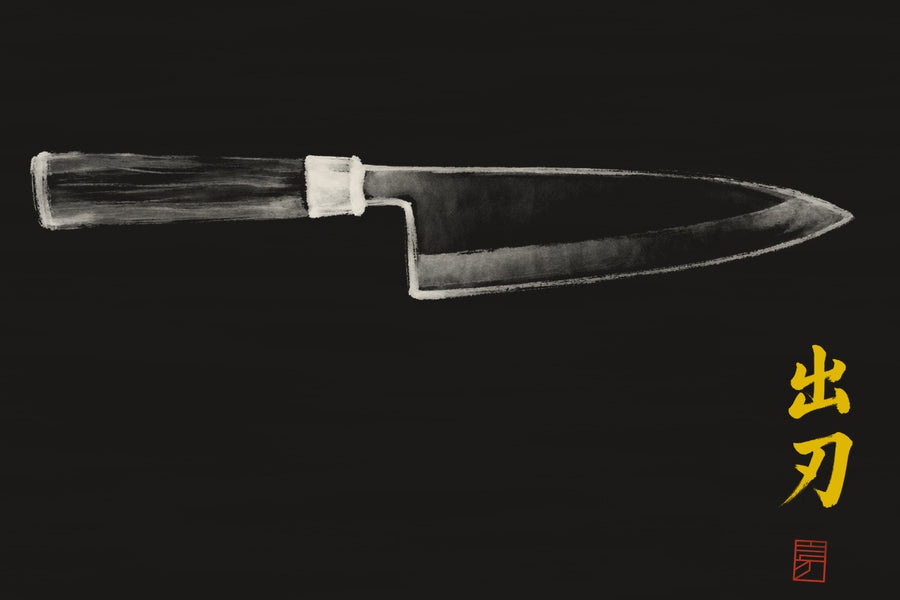
Deba — knife profile
Profile

Deba

出刃

Japanese fish knife · Single or double bevel

A thick, heavy fish knife; dictionaries say it fillets and cuts fish and fowl bones.

Read more
Steel properties
  1. Hardness Very good
  2. Edge retention Good
  3. Toughness Good
  4. Rust resistance Low
  5. Ease of sharpening High
  6. Sharpness Very high
Our ratings, inferred from published lab tests and composition.

Our edge-retention grade is a kitchen rating. It weighs the hardness each steel is sold at, which keeps a thin edge from rolling, twice as heavily as lab wear tests, and the final grade is our judgment from selling and sharpening these knives for over a decade. Lab card-cutting tests measure abrasive wear only, so they can rank carbon steels lower. Tap ? for the lab figure.

Steel

White 2 / Shirogami #2

白二鋼

Carbon · Hitachi Metals (now Proterial)

Proterial carbon steel, 1.05 to 1.15% carbon, no chromium or tungsten; not stainless.

Read more
CladdingCoreClad line
Construction

Sanmai - Soft Iron Clad

三枚・軟鉄

3 layers · soft iron clad

Hard core between two soft iron layers, bare at the edge. The iron patinas and rusts.

Read more
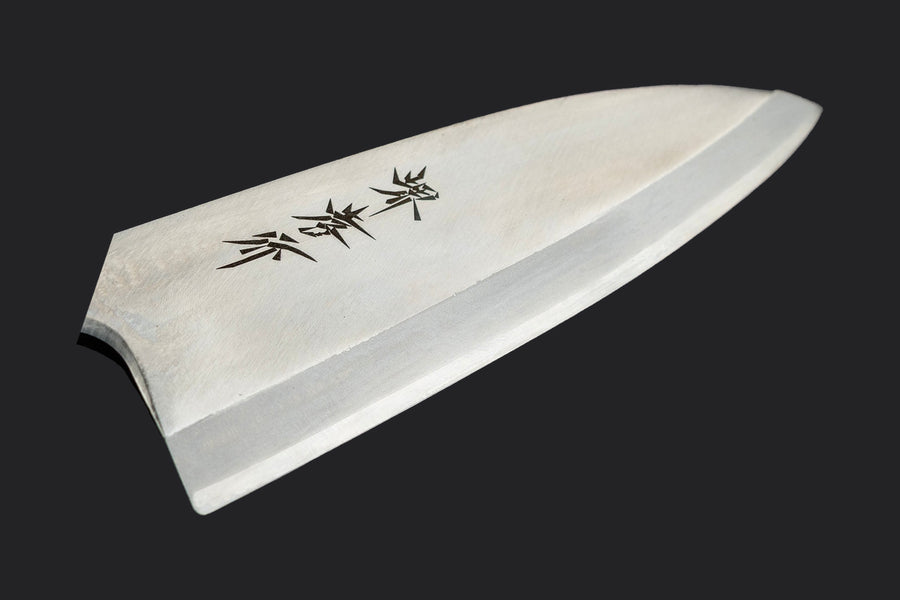
Migaki — blade surface finish
Finish

Migaki

磨き

Polished satin

Smooth polished surface, satin to soft sheen rather than mirror. Scratches show.

Read more
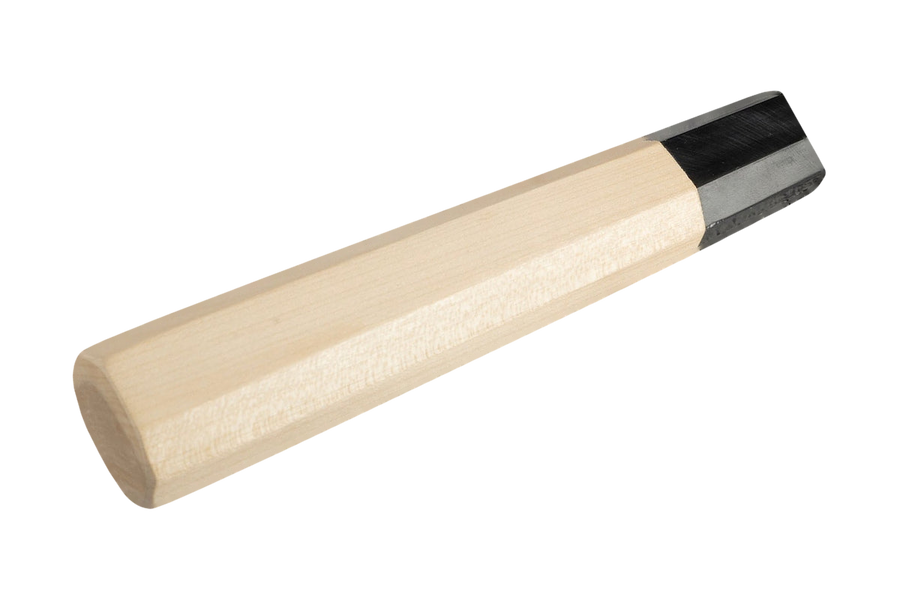
Ho Wood Octagonal handle
Handle

Ho Wood Octagonal

Octagonal WA

Light, pale ho wood (Japanese magnolia), eight-sided, with a synthetic horn ferrule.

Frequently asked questions

Can a deba cut bone?

Yes, the bones of fish and fowl. Japanese dictionaries describe the deba (出刃包丁) as wide, thick-spined and heavy, used to fillet fish, to cut fish and fowl bone and all, and for rough chopping.

When you chop bone, use the heel of the blade (刃元), the Sakai cutlery association says. It is a fish and poultry knife, not a cleaver.

Can left-handed cooks use single bevel knives?

A standard single bevel knife is ground for right-handed use, and a left-handed one is made with the bevel reversed. Some makers offer left-handed versions.

Contact us and we will check what we can order or have in stock.

What is a mioroshi deba?

A mioroshi deba is a longer, slimmer version of the Japanese fish-butchering knife (deba), made for filleting. It keeps the deba's single bevel but is narrower, thinner at the spine and much lighter for its length.

A standard deba is thick and heavy, deep at the heel, and typically 150mm to 210mm long. Its weight and thick spine do the work when you take off a head or cut through a spine. The mioroshi deba gives up some of that weight for length: the ones we list are 210mm, 240mm and 270mm.

Our measurements show the difference. In Masamoto Sohonten's KS line, the 210mm mioroshi deba weighs 209g against 382g for the 210mm deba, and its spine above the heel is 4.8mm thick against 7.1mm.

Like the deba it is single bevel, so each knife is made for one hand. Most are right-handed, and we list left-handed ones too. Ours come from Sakai Takayuki, Masamoto Sohonten, Nakagawa and the Hatsukokoro Shirasagi line, in White 2 and Blue 1 carbon steel and in stainless.

Choose the standard deba if most of your work is heads and spines, because that work needs the weight. Choose the mioroshi deba when filleting is most of the job. Our deba guide explains the family, and both are listed with our deba and fish filleting knives.

Why is the back of a single-bevel knife hollow, and how do I sharpen it?

The shallow hollow in the back is called urasuki (裏スキ). Tojiro explains that it means the whole back never has to be ground when you sharpen, makes it easier to keep the back flat, and stops sharpening the back from affecting the edge. Only the thin flat rim around the hollow touches the stone.

Sharpen the front bevel first, laying it flat on the stone. Then lay the back completely flat and take a few light strokes, just enough to remove the burr. Never lift the spine to put an angle on the back, and keep the stone itself flat.

Which knife do I need for sushi and sashimi at home?

For occasional sushi at home, a sharp sujihiki (筋引) does the job. Tojiro describes it as a long, double-bevel slicer that can also be used for sashimi, and a double bevel works in either hand.

If sashimi is the point of the meal, choose a yanagiba (柳刃). Tojiro calls it the Kansai-style sashimi knife, now used across Japan, and it slices in one long pull from heel to tip. It is single bevel, so buy the one made for your hand.

If you start from whole fish, add a deba (出刃). Tojiro describes it as very thick and heavy, made for breaking fish down. The deba takes the fish apart and the slicer then cuts the fillets.

Shirogami 1 vs Shirogami 2: what is the difference?

Shirogami 1 (White 1) has more carbon than Shirogami 2 (White 2): Proterial lists 1.25 to 1.35% carbon for Shirogami 1 and 1.05 to 1.15% for Shirogami 2, with the same silicon (0.10 to 0.20%) and manganese (0.20 to 0.30%) ranges for both.

Proterial describes both as carbon steel with minimum impurities, Shirogami 1 with the highest hardness and Shirogami 2 with high hardness, and gives a hardening hardness of over 60 HRC for both. It lists Shirogami 1 for the highest quality tipped tools, planes, chisels and razors, and Shirogami 2 for high quality tipped tools, chisels, razors, sickles, axes and gravers.

What is the difference between White 1, White 2 and White 3?

White 1, White 2 and White 3 are Proterial's Shirogami 1, Shirogami 2 and Shirogami 3. Proterial lists carbon at 1.25 to 1.35% for Shirogami 1, 1.05 to 1.15% for Shirogami 2 and 0.80 to 0.90% for Shirogami 3, with the same silicon and manganese ranges for all three and no chromium listed.

Proterial describes all three as carbon steel with minimum impurities, at highest, high and middle hardness in that order, and gives a hardening hardness of over 60 HRC for each.

What is the difference between Blue 2 and White 2 steel?

Blue 2 is White 2 with tungsten and a little chromium added. Blue 2 holds its edge longer. White 2 sharpens faster and takes a very keen edge. Both are carbon steels that will rust if left wet.

The figures come from Proterial, which makes both. Each has 1.05 to 1.15% carbon. Blue 2 (Aogami 2) adds 1.00 to 1.50% tungsten and 0.20 to 0.50% chromium. White 2 (Shirogami 2) lists neither, and Proterial describes it as a carbon steel with minimum impurities. Proterial says the tungsten and chromium improve heat treatment and wear resistance, and gives a hardening hardness over 60 HRC for both.

In use, the tungsten forms hard carbides that resist wear, so a Blue 2 edge lasts longer between sharpenings. White 2 has none, so it comes back on a whetstone very quickly. The chromium in Blue 2 is far below the 10.5% a steel needs to be stainless, so it gives no real rust protection. Wipe either steel dry after use and expect a patina.

Choose Blue 2 if you want to sharpen less often. Choose White 2 if you enjoy sharpening and want the keenest edge. We list both widely: Blue 2 from Nigara, Myojin Riki and Anryu, and White 2 from Masamoto Sohonten, Sakai Takayuki and Yoshikane.