


Yu Kurosaki Shizuku SG2 Gyuto 240mm
Yu Kurosaki Shizuku SG2 Gyuto 240mm is backordered and will ship as soon as it is back in stock.
Sold out right now
Leave your email and we’ll send one message the moment it’s back in stock.
One email, no marketing. Privacy policy.
We match the delivered price (including shipping) of in-stock items from reputable specialist knife retailers. Clearance and pre-owned items excluded. Each request is checked by our team.
Availability
Delivery unavailable for this item. Available for in-store pickup only.
-
St Peters, NSW —2 Bishop St, Unit 2, St Peters NSW 2044
-
Crows Nest, NSW —107 West St, Shop 1, Crows Nest NSW 2065Pickup only
-
Prahran, VIC —180 Commercial Road, Shop 1, Prahran VIC 3181Pickup only
Detailed Specifications
| Line | Kurosaki Shizuku |
| Profile | Gyuto / Chef's knife |
| Bevel Type | Double Bevel |
| Weight | 199 g | 7.0 oz |
| Edge Length | 242 mm | 9 17/32″ |
| Heel Height | 56 mm | 2 13/64″ |
| Width @ Heel | 3.3 mm | 1/8″ |
| Width @ Mid | 2.2 mm | 3/32″ |
| Width @ 1cm from Tip | 1.0 mm | 3/64″ |
| Steel | SG2 / R2 | Powdered | Stainless |
| Blade Construction | Sanmai - Stainless Clad |
| Hardness (HRC) | 62 - 64 |
| Surface Finish | Tsuchime |
| Handle | Special Handle |
| Region | Takefu |
| Best for |
|
| Pros | Cons |
|
|
- Don't cut hard things! Japanese knives are brittle so bone hacking is a NO NO!
- Wash with neutral detergent after use, and wipe dry;
- Please don't wash knife with dishwasher, it will damage the wood handle;
- Be careful not to leave the knife close to a heat source for a long time;
- It is a lot more dangerous to cut with a blunt knife than a sharp knife!
- It is best to sharpen a Japanese knife regularly on a waterstone.
Knife details
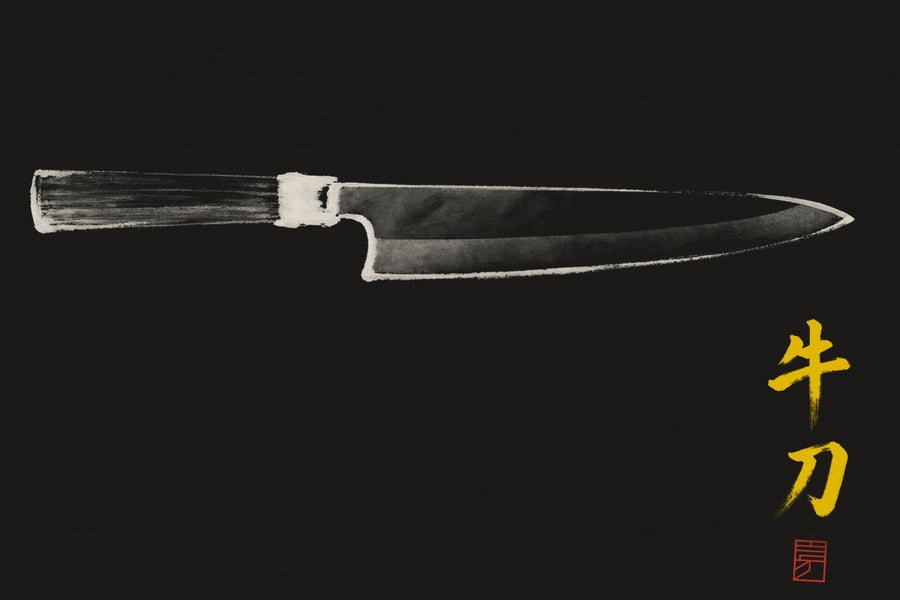
Gyuto
牛刀
Chef's knife · Double bevel
Double-bevel all-purpose chef's knife with a pointed tip; thinner than a Western one.
Read moreSG2 / R2
スーパーゴールド2
Stainless · Takefu Special Steel
Takefu powder stainless, 62+ HRC. Long edge; resists rust.
Read moreSanmai - Stainless Clad
三枚
3 layers · stainless clad
Hard core between two stainless layers, bare only at the edge; the cladding resists rust.
Read more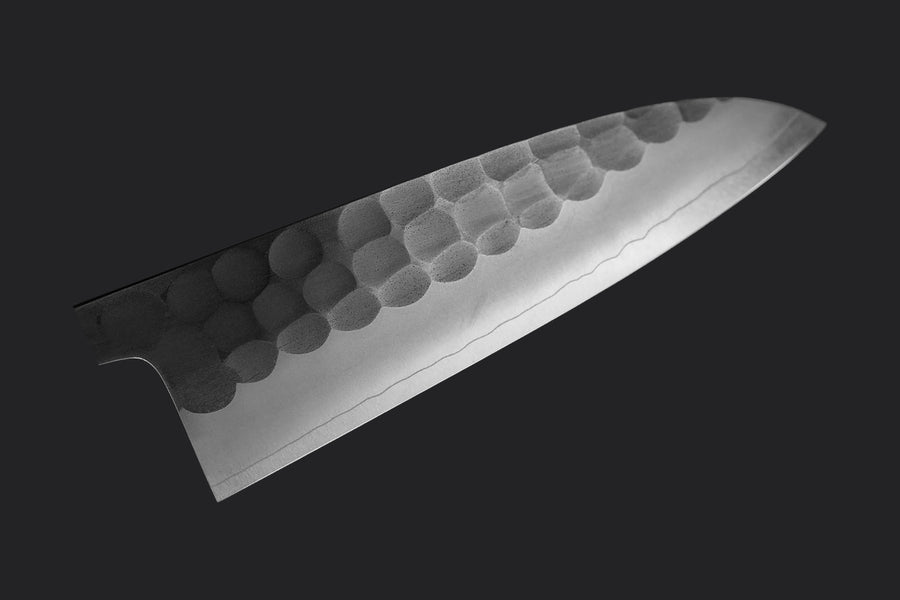
Tsuchime
Hammered surface
Hammer marks across the upper blade. The dimples may help food release.
Read more
