Crows Nest store now open from Friday to Tuesday, 10am till 6pm.

Shiro Kamo  |  SKU: KAMO_KU_GY240

Shiro Kamo Seilan AS Kurouchi Gyuto 240mm

Regular price $249.95
Tax included Shipping calculated at checkout.

IMPORTANT: Carbon steel knives can rust or patina quickly if not cared for properly. They require regular cleaning, drying, and oiling. If you are unfamiliar with carbon steel maintenance, we recommend choosing a stainless steel option instead.

Availability

  • St Peters
    2 Bishop St Unit 2 St Peters NSW 2044
  • Crows Nest
    107 West St, Crows Nest NSW 2065
    Pickup only
Detailed Specifications
Line Shiro Kamo Blue Super Kurouchi (Seilan)
Profile Gyuto / Chefs Knife
Bevel Type Double Bevel
Weight 196 g        6.91 oz
Edge Length 243 mm   .9.57 inch
Heel Height 46 mm     .1.81 inch
Width @ Spine 3.1 mm     0.12 inch
Width @ Mid 2.0 mm     0.08 inch
Width @ 1cm from Tip 1.0 mm     0.04 inch
Steel Blue Super / Aogami Super | Carbon
Blade Construction Sanmai - Soft Iron Clad
Hardness (HRC) 62 - 65
Surface Finish Kurouchi
Handle Octagonal Teak Handle
Region Echizen
Best for
  • Pro chefs
  • Enthusiasts
    • Free shipping for knives over AU$200 Australia wide.
    • World-wide shipping via DHL Express, 3 to 5 days.

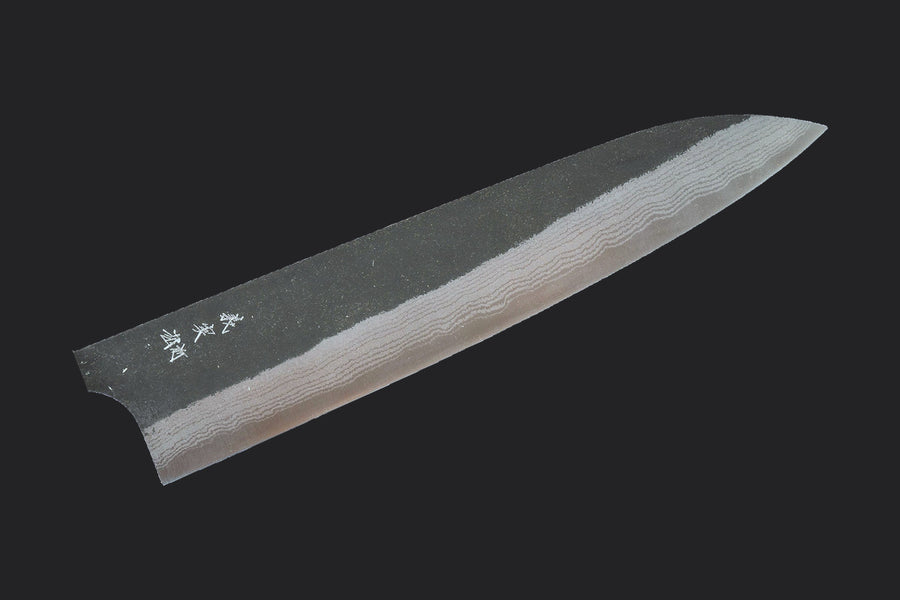
    The Shiro Kamo Seilan AS Kurouchi Gyuto 240mm is a double-bevel Japanese chef's knife featuring Aogami Super carbon steel, best fit for users seeking an Echizen-forged blade with broad profile geometry. Forged by Shiro Kamo, a certified traditional craftsman and former chairman of the Takefu Knife Village, this 243mm edge length gyuto serves general purpose kitchen tasks including mincing, slicing, and chopping vegetables or meat. The kurouchi surface finish presents the blade in its traditional blacksmith scale state.

    This san-mai construction features soft iron cladding over a reactive Aogami Super core that requires drying after use to prevent oxidation. The steel achieves 62-65 HRC hardness with high carbon and tungsten content for edge retention, while added vanadium increases toughness. Measuring 3.1mm at the heel and tapering to 1.0mm at the tip, the blade weighs 196g with a 46mm heel height. Shiro Kamo maintains a deliberately small lineup of perfected designs, applying expert forging techniques to create thin bevels paired with this high-hardness carbon steel.

    Care Instruction
    1. Don't cut hard things! Japanese knives are brittle so bone hacking is a NO NO!
    2. Wash with neutral detergent after use, and wipe dry;
    3. Please don't wash knife with dishwasher, it will damage the wood handle;
    4. Be careful not to leave the knife close to a heat source for a long time;
    5. It is a lot more dangerous to cut with a blunt knife than a sharp knife!
    6. It is best to sharpen a Japanese knife regularly on a waterstone.
    7. Oil the (carbon) knife if storing for an extended period of time to prevent rust.

    Shiro Kamo

    Shiro Kamo, the second generation blade smith of the Kamotou Hamono, is an expert of forging. He only keep feel designs but they are tuned to near perfect. Kamo san's knife is known for the broad profile and extreme thin bevel, paired with high hardness SG2 and Blue Super steel, his blades are some of the best cutters especially for hard and dense vegetables.

    It is worth mentioning Kamo san do forge stainless and carbon steel alike, while the SG2 is much hard to deform under forging temperature, he seems to be able to command steel into his desired shape with little effort. His understanding and experience in forging and sharpening lead to incredibly well polished designs, which excels in handling, lightness and cutting smoothness.

    • Profile: Gyuto

      Chefs Knife

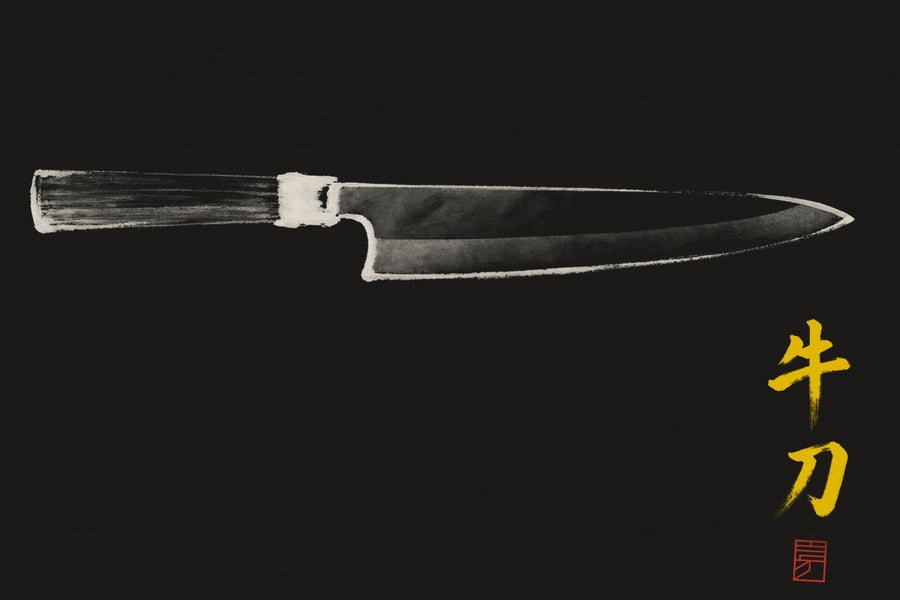
      A Japanese chef's knife is known as a gyuto (牛刀 ぎゅうとう) gyūtō), literally meaning 'beef knife'. Its blade resembles a flatter version of a French chef's knife. Japanese cutlery is known for sharpness due to its acute blade geometry, and the hardness of the steel used, sometimes exceeding 60 HRC on the Rockwell Scale A typical western chef's knife may be sharpened to an edge angle of 20-22°, while a Japanese gyuto generally has a sharper edge angle of 15-18° (or even lower), which requires a harder, more brittle grade of steel. In recent years Japanese gyuto have gained in popularity with western chefs.

      A modern chef's knife is a multi-purpose knife designed to perform well at many differing kitchen tasks, rather than excelling at any one in particular. It can be used for mincing, slicing, and chopping vegetables, slicing meat, and disjointing large cuts.

      Slide for more >>

    • Steel: Blue Super / Aogami Super

      Aogami Super steel, also known as Blue Super Steel, is highly esteemed among Japanese carbon steels for its exceptional qualities. Produced by Hitachi Metals Ltd., this steel surpasses Blue Steel No.1 in its composition, featuring higher amounts of carbon and tungsten, with the addition of vanadium. Aogami Super is celebrated for its remarkable edge sharpness and superior edge retention capabilities. It can achieve high levels of hardness without becoming brittle, a characteristic that sets it apart and endears it to knife enthusiasts worldwide. The steel's enhanced carbon content enables it to maintain sharpness for extended periods, while the added chromium aids in rust resistance. A touch of vanadium increases its toughness, making it less prone to chipping. These attributes make Aogami Super one of the most revered high carbon steels globally, often described as a knife nerd's dream for its balance of hardness, durability, and maintenance ease.

      Manufacturer:

      • Hitachi Special Steel, Japan

      Nature: Carbon

      Hardness: 62- 65

      << Slide for more >>

    • Handle Specs

      Profile: Octagonal WA

      Material:

      • Teak

      One-piece octagonal teak handle

      << Slide for more

    Liquid error (sections/product-recommendations line 9): Could not find asset snippets/kns-product-recs.liquid