PRAHRAN STORE NOW OPEN · THU–MON · 10AM–6PM

Sakai Takayuki  |  SKU: TAK_SW_GRYANAGI30

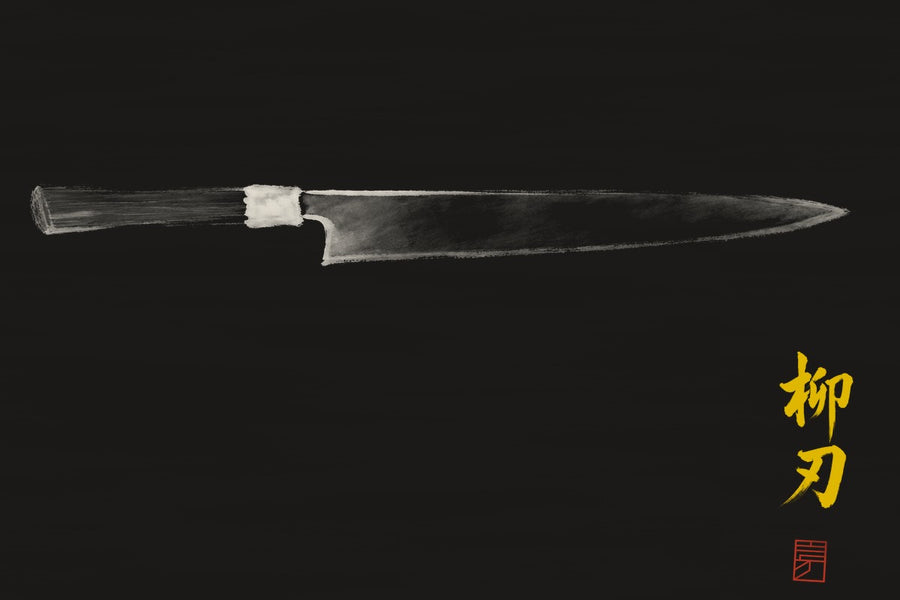
Sakai Takayuki GinRyu (銀龍) Swedish Steel Honyaki Yanagiba 300mm, Marble Horn Ebony Handle

Sale price $1,019.98 Regular price $1,199.95

Availability

  • St Peters, NSW —
    2 Bishop St, Unit 2, St Peters NSW 2044
  • Crows Nest, NSW —
    107 West St, Shop 1, Crows Nest NSW 2065
    Pickup only
  • Prahran, VIC —
    180 Commercial Road, Shop 1, Prahran VIC 3181
    Pickup only

Goes well with

Detailed Specifications
Line Sakai Takayuki GinRyu (銀龍) Swedish Steel Honyaki
Profile Yanagiba / Sashimi knife
Bevel Type Single Bevel
Weight 273 g | 9.6 oz
Edge Length 292 mm | 11 1/2″
Heel Height 39 mm | 1 17/32″
Width @ Heel 3.3 mm | 1/8″
Width @ Mid 2.9 mm | 7/64″
Width @ 1cm from Tip 1.0 mm | 3/64″
Steel Swedish Steel | Stainless
Blade Construction Monosteel
Handle
Region Sakai
Best for
  • Collectors
  • Pro chefs
  • Enthusiasts

Free shipping for knives over AU$200 Australia wide.

World-wide shipping via DHL Express, 3 to 6 days (not available in the UK).


GinRyu (銀龍, Silver Dragon) is an artisan line from Sakai Takayuki, in the Artisan knives range. Aoki sells these as honyaki: one piece of through-hardened Swedish stainless steel, with no cladding and no hamon, so the blade stays bright with far less care than a carbon honyaki.

The flip side is honest: the hard, through-hardened edge can chip under torque or a bad board, and sharpening one of these back to shape is specialist work. With proper technique the edge lasts a long time between sharpenings. This is a knife for someone who already knows single bevel technique.

Pros Cons
  • Excellent performance
  • Highly collectable
  • Exceptional profile
  • High budget
  • Relatively hard to sharpen
  • A little bit brittle
Care Instruction
  1. Don't cut hard things! Japanese knives are brittle so bone hacking is a NO NO!
  2. Wash with neutral detergent after use, and wipe dry;
  3. Please don't wash knife with dishwasher, it will damage the wood handle;
  4. Be careful not to leave the knife close to a heat source for a long time;
  5. It is a lot more dangerous to cut with a blunt knife than a sharp knife!
  6. It is best to sharpen a Japanese knife regularly on a waterstone.

Sakai Takayuki

Aoki Hamono, the family company behind Sakai Takayuki.

Sakai Takayuki is the knife brand of Aoki Hamono Seisakusho (青木刃物製作所), a family company in Sakai, Osaka, now in its third generation. Ichiro Aoki founded the business in 1947; the second generation, Takayuki Aoki, gave the brand 堺孝行 its given name; and the third, Takahiro Aoki, is president. Sakai's knife tradition goes back over 600 years, which is the region's history, not the company's age. Aoki Hamono sells to customers in more than 20 countries.

The business began in Osaka as a wholesaler of Sakai forged knives. It opened an office in Sakai and took the name Aoki Hamono Seisakusho in 1963, and registered the Sakai Takayuki trademark in 1964. The Sanpou factory in Sakai followed in 1977, and blacksmiths and sharpeners joined it in 1978. In 2015 Sanpou was renovated with an automatic grinding machine for Japanese knives.

Sakai splits the work of knifemaking: forging, grinding and sharpening are done by different specialists. Aoki's craftsman page lists eight blacksmiths and seven sharpeners, six of them certified traditional craftsmen. Kenji Togashi is a certified blacksmith whose specialty is honyaki and forged knives. Itsuo Doi forges for Sakai Takayuki; he trained under his father, Keijiro Doi, whom Aoki calls a master smith. A smith of the Yamatsuka family works Ginsan, a stainless steel Aoki says is rare in Sakai, and learned to forge it from his father. Among the sharpeners, Mitsuo Yamatsuka is a certified traditional craftsman whose specialties are single-bevel, mirror and double-bevel sharpening, and Hirotsugu Tosa, who died in 2025, did honyaki and mirror-finish sharpening.

The company's range runs from Japanese and Western knives to pastry, Chinese and soba knives, and what we list is a slice of it. The single-bevel knives are the Tokujou line in White 2 carbon, Ginsan deba and yanagiba under Ginsanko and Gintan, and the stainless single-bevel INOX line. The double-bevel lines are Kurokage in VG10, the SPG2 line, Ginga in ZA-18 Damascus, and the Blue 2 knives Homura Guren and Aoniko. The honyaki we list are a Kenji Togashi honyaki gyuto and the GinRyu Swedish steel honyaki yanagiba, and the two craftsman lines are Byakko by Kenji Togashi and Hien by Itsuo Doi. We also list a bread knife and pastry spatulas.

“Three generations of Sakai knives since 1947.”

Est. 1947 | 昭和22年
Known for Classic Sakai knives, unique engraving.
Website aoki-hamono.co.jp Instagram @sakaitakayuki_knife_gallery Read more about Sakai Takayuki

Sakai Takayuki · Sakai

Knife details

Frequently asked questions

What is a yanagiba knife used for in sushi preparation?

A yanagiba (柳刃包丁) is a sashimi knife for slicing raw fish. A knife maker's guide says a sashimi knife cuts without breaking the fibres of the flesh, and that it is longer and narrower than other knives because slicing sashimi with crisp edges needs the length.

The whole length goes through one pulling cut. The Sakai cutlery association calls the yanagiba the sashimi knife used mainly in the Kansai region.

What size yanagiba should I buy?

Size a yanagiba to the fish you prepare: a knife maker's guide gives 270 to 360 mm for professional use and 240 to 270 mm for home use, with 270 mm at home if you slice larger fish.

The guide says the whole length goes through one pulling cut, so do not choose too short a knife, and at home it points to the size of your board and your work space. We list the yanagiba (柳刃) from 210 to 360 mm, some made for left-handed use.

Can a yanagiba cut through fish bones?

No. The Sakai cutlery association describes the yanagiba (柳刃包丁) edge as so acute that it cannot be used on hard things such as bones.

For bones the association describes the deba (出刃包丁), whose heel is used to hit them.

Takohiki or yanagiba: what is the difference?

An encyclopedia describes sashimi knives as thin and narrow, calling the pointed ones yanagiba and the unpointed ones takohiki. A sakimaru takohiki is the rounded-tip variant, so it has a rounded point despite its takohiki name.

A trade body, the Sakai cutlery association, calls the takohiki (たこ引き包丁) the Kanto-type sashimi knife, and the yanagiba the sashimi knife used mainly in Kansai, with an acute edge that is not for bone.

Sujihiki or yanagiba: which do I need?

Most home cooks need the sujihiki. Choose the yanagiba when slicing raw fish for sashimi and sushi is the main job and you are prepared to learn single bevel sharpening.

A sujihiki is a long, narrow, double bevel slicer. Tojiro describes it as the knife for dividing large pieces of meat, known abroad as a slicer or carving knife, and says its length lets it cut sashimi as well. It carves roasts, trims sinew and portions fish, works in either hand and sharpens like any double bevel knife. Sujihiki run from about 210 to 300 mm, and 240 mm suits most home boards.

A yanagiba is the single bevel sashimi knife. It is ground on one side with a hollow back, and each slice is one long pull from heel to tip, so raw fish is cut cleanly rather than sawn. The edge is too fine for bones or anything hard. It is made for one hand and most are right handed, so check the listing if you are left handed. Sharpening means working the whole bevel and keeping the back flat. Yanagiba run from about 240 to 330 mm, with 270 and 300 mm the common sizes.

So for roasts, portioning meat and the occasional side of fish, buy a sujihiki. For regular sashimi and sushi work, buy a yanagiba and keep it for fish.

Why is the back of a single-bevel knife hollow, and how do I sharpen it?

The shallow hollow in the back is called urasuki (裏スキ). Tojiro explains that it means the whole back never has to be ground when you sharpen, makes it easier to keep the back flat, and stops sharpening the back from affecting the edge. Only the thin flat rim around the hollow touches the stone.

Sharpen the front bevel first, laying it flat on the stone. Then lay the back completely flat and take a few light strokes, just enough to remove the burr. Never lift the spine to put an angle on the back, and keep the stone itself flat.

Which knife do I need for sushi and sashimi at home?

For occasional sushi at home, a sharp sujihiki (筋引) does the job. Tojiro describes it as a long, double-bevel slicer that can also be used for sashimi, and a double bevel works in either hand.

If sashimi is the point of the meal, choose a yanagiba (柳刃). Tojiro calls it the Kansai-style sashimi knife, now used across Japan, and it slices in one long pull from heel to tip. It is single bevel, so buy the one made for your hand.

If you start from whole fish, add a deba (出刃). Tojiro describes it as very thick and heavy, made for breaking fish down. The deba takes the fish apart and the slicer then cuts the fillets.

Is Swedish steel stainless?

The makers use different wording. Masamoto Sohonten labels its Swedish steel rust-resistant, while Aoki Hamono lists Sakai Takayuki GinRyu SW as stainless for professional use.

Neither maker names the grade. The Japan Stainless Steel Association defines stainless as an iron-based alloy with 10.5% chromium or more that rusts less, so wash and dry these knives after use anyway.

You May Also Like