Crows Nest store now open from Friday to Tuesday, in store specials!

Hatsukokoro  |  SKU: HATS-VT2HNTR-GY210

Hatsukokoro Hinotori V-Toku 2 Gyuto 210mm Rainbow Damascus Finish

Regular price $459.95

IMPORTANT: Carbon steel knives can rust or patina quickly if not cared for properly. They require regular cleaning, drying, and oiling. If you are unfamiliar with carbon steel maintenance, we recommend choosing a stainless steel option instead.

Add a saya or K&S Knife Roll to receive $20 bundle discount!

Detailed Specifications
Line Hatsukokoro Hinotori VToku-2
Profile Gyuto / Chefs Knife
Bevel Type Double Bevel
Weight 136 g | 4.8 oz
Edge Length 215 mm | 8 15/32″
Heel Height 45 mm | 1 49/64″
Width @ Spine 1.7 mm | 1/16″
Width @ Mid 1.6 mm | 1/16″
Width @ 1cm from Tip 0.9 mm | 1/32″
Steel V-Toku 2 | Carbon
Blade Construction Sanmai - Stainless Damascus Clad
Hardness (HRC) 62 - 64
Surface Finish Etched
Handle Special Handle
Region Hyogo
Best for
  • Enthusiasts
  • Pro chefs
    • Free shipping for knives over AU$200 Australia wide.
    • World-wide shipping via DHL Express, 3 to 5 days.


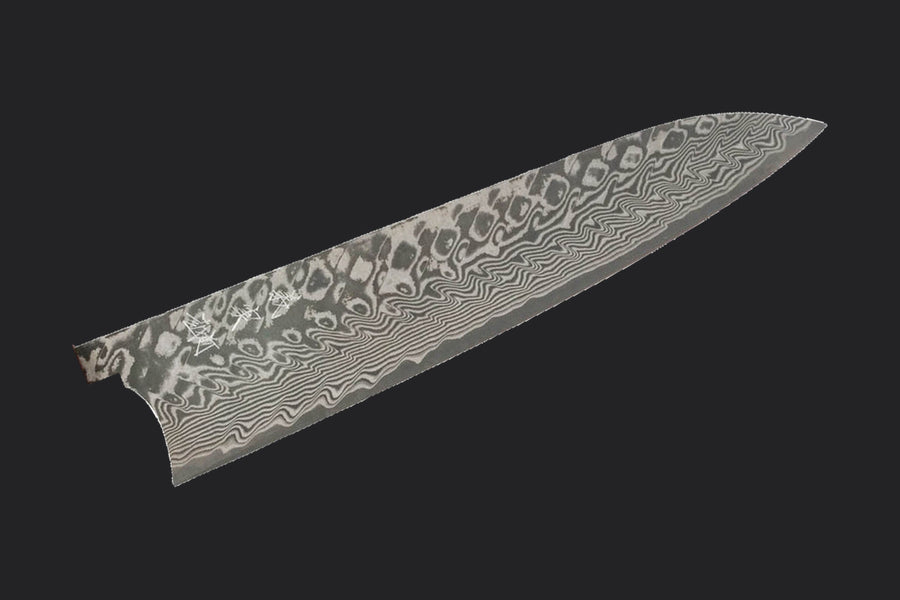
    The Hatsukokoro Hinotoro Line is a bold expression of craftsmanship and performance. Its striking copper and brass damascus flows across the blade in dramatic, flame-like waves—true to its name, Hinotori, evoking fire in motion. But this is far more than just visual theatre. Beneath the etched surface lies a serious core: V-Toku 2 high carbon steel from Takefu Special Steel Co.


    Often compared to Hitachi Blue #2, V-Toku 2 features over 1% carbon, along with tungsten and vanadium, delivering excellent edge retention and a refined cutting feel. Hardened to 62–64 HRC, it offers performance on par with top-tier Blue #2 blades. Produced by the same company behind our Kujaku line, the Hinotoro shares the same outstanding cutting performance, now enhanced with a deeper etched finish for greater contrast and presence.


    Finished with an exotic Amboyna handle and genuine blonde buffalo horn ferrule, the warm tones perfectly complement the blade’s palette. As with all carbon steel knives, proper care is essential to prevent rust and maintain its beauty.

    Pros Cons
  • Great artistic
  • Excellent fit and finish
  • Excellent performance
  • Relatively hard to sharpen
  • Prone to rust

  • Care Instruction
    1. Don't cut hard things! Japanese knives are brittle so bone hacking is a NO NO!
    2. Wash with neutral detergent after use, and wipe dry;
    3. Please don't wash knife with dishwasher, it will damage the wood handle;
    4. Be careful not to leave the knife close to a heat source for a long time;
    5. It is a lot more dangerous to cut with a blunt knife than a sharp knife!
    6. It is best to sharpen a Japanese knife regularly on a waterstone.
    7. Oil the (carbon) knife if storing for an extended period of time to prevent rust.

    Hatsukokoro

    Hatsukokoro as a brand works extensively with the Japanese kitchen knife industry. Through collaboration with makers and manufacturers across the Japan, they’ve designed and created a huge collection of different knives, covering every possible price range while having a great value in many of their product lines. Their capabilities to incorporate resources have built a strong relation with knife makers, and more and more are happy to send their knives down to Amagasaki and have them delivered across the world.

    • Profile: Gyuto

      Chefs Knife

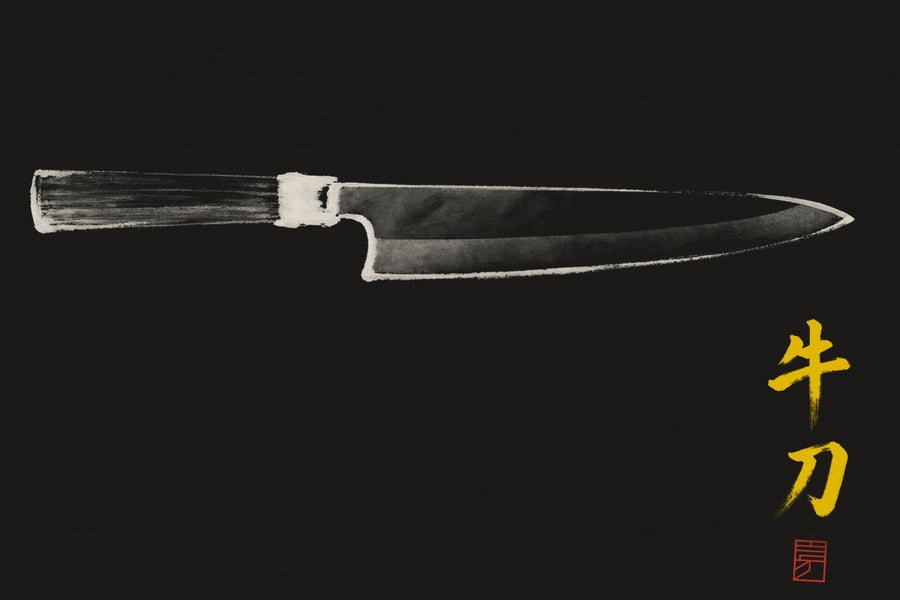
      A Japanese chef's knife is known as a gyuto (牛刀 ぎゅうとう) gyūtō?), literally meaning 'beef knife'. Its blade resembles a flatter version of a French chef's knife. Japanese cutlery is known for sharpness due to its acute blade geometry, and the hardness of the steel used, sometimes exceeding 60 HRC on the Rockwell Scale A typical western chef's knife may be sharpened to an edge angle of 20-22°, while a Japanese gyuto generally has a sharper edge angle of 15-18° (or even lower), which requires a harder, more brittle grade of steel. In recent years Japanese gyuto have gained in popularity with western chefs.

      A modern chef's knife is a multi-purpose knife designed to perform well at many differing kitchen tasks, rather than excelling at any one in particular. It can be used for mincing, slicing, and chopping vegetables, slicing meat, and disjointing large cuts.

      Slide for more >>

    • Steel: V-Toku 2

      V-Toku 2(V特2号, V-Special 2) is Takefu Special Steel's take on the classic Hitachi Blue 2 Steel. As a alloy carbon steel, its chemical composition is very close to Blue 2 with some addition of Vanadium, combined with the higher claimed purity by Takefu, V-Toku 2 should have a slight improved wear resistance than the Blue 2.

      V-Toku 2 have excellent hardenability, which allows it to be brought up to HRC64, many makers will take advantage of the hardness to produce razor-thin blade that will slice through food extremely well. As Takefu also produce laminated billets with copper or bronze layers, V-Toku can also be seen on knives from European and American makers, which allows many chefs to benefit from the excellent cutting experience of a carbon steel knife.

      Manufacturer:

      • Takefu Special Steel, Japan

      Nature: Carbon

      Hardness: 62- 64

      << Slide for more >>

    • Construction: Sanmai - Stainless Damascus Clad

      Sanmai(Three-Piece) is a common construction for double bevel knives where two pieces of softer cladding steel are forgewelded to each side of a harder core steel. The harder but more brittle core steel will form the hard cutting edge after heat treating, and the softer cladding will support the core to increase the overall strength of the blade.

      Damascus Sanmai utilize damascus steel as the cladding material for the Sanmai construction, which adds aesthetic feature to the blade. On the Kitchen knives with stainless core steel, the damascus cladding will be stainless, this means they will also protect the carbon/semi-stainless core from rusting/discolouration.

      The soft cladding enables the thinning process to be a lot easier than a honyaki or monosteel construction. However, when the cladding is made of damascus, whether etched, polished or mirror polished, the thinning process will take a toll on the cladding, meaning the damascus won't look the same as when it was taken out of the box.

      << Slide for more >>

    • Finish: Etched

      The etching process starts with the knife being thoroughly cleaned to remove any oils or residues. A protective mask may be applied to the areas not intended to be etched. The blade is then submerged in an acidic solution, such as ferric chloride, which reacts with the different layers of steel at varying rates. This creates a layer of dark oxide on the surface of the blade where the thickness of the oxide varies according to the reactiveness of the steel. After etching, the knife is neutralized in a baking soda solution, rinsed, and dried. The final step involves polishing the blade to highlight the etched design, enhancing both the knife's beauty and showcasing the craftsmanship of its maker.

      << Slide for more >>

    • Handle Specs

      Profile: Octagonal WA

      Material:

      • Unknown

      A unique handle crafted by the hamono, with the material undisclosed.

      << Slide for more