Crows Nest store now open from Friday to Tuesday, in store specials!

Hatsukokoro  |  SKU: HATS-VT2KJK-SA180-BLUE

Hatsukokoro Kujaku V-Toku-2 Santoku 180mm Rainbow Damascus Finish

Regular price $339.95

IMPORTANT: Carbon steel knives can rust or patina quickly if not cared for properly. They require regular cleaning, drying, and oiling. If you are unfamiliar with carbon steel maintenance, we recommend choosing a stainless steel option instead.

Pickup available at 2 Bishop St

Usually ready in 24 hours

Add a saya or K&S Knife Roll to receive $20 bundle discount!

Hatsukokoro Kujaku V-Toku 2
Santoku
Double Bevel
Weight 157 g | 5.5 oz
Edge Length 180 mm | 7 3/32″
Heel Height 46 mm | 1 13/16″
Width @ Heel 2.3 mm | 3/32″
Width @ Mid 2.2 mm | 3/32″
Width @ 1cm from Tip 1.1 mm | 3/64″
Steel V-Toku 2 | Carbon
Blade Construction Sanmai - Stainless Damascus Clad
Hardness (HRC) 62 - 64
Surface Finish Etched
Handle Octagonal Colored-handle with Acrylic Ferrule
Region Hyogo
Best for
  • Enthusiasts
  • Pro chefs
  • Free shipping for knives over AU$200 Australia wide.
  • World-wide shipping via DHL Express, 3 to 5 days.


The Rainbow Damascus is no longer rare in the industry, but I think many of us still remember how stunning it was when we first came across it. Hatsukokoro didn't settle on their Hayabusa Blue 2 Rainbow Damascus line but decided to push it even further, which leads to this brand new line Kujaku(孔雀, Peacock)which is an upgrades in all aspects compare to the Hayabusa.

The core steel of the Kujaku is Takefu Special Steel's V-Toku 2, which is Takefu's take on the classic Blue 2 steel. With the introduction of vanadium and a bit more tungsten, the increased dine carbide would give V-Toku better wear resistance than Blue steels from Hitachi. Meanwhile, being an alloy carbon steel, it still retains excellent working hardness up to HRC64 and can produce a really fine cutting edge, which is what people look for when they are getting a carbon steel knife.

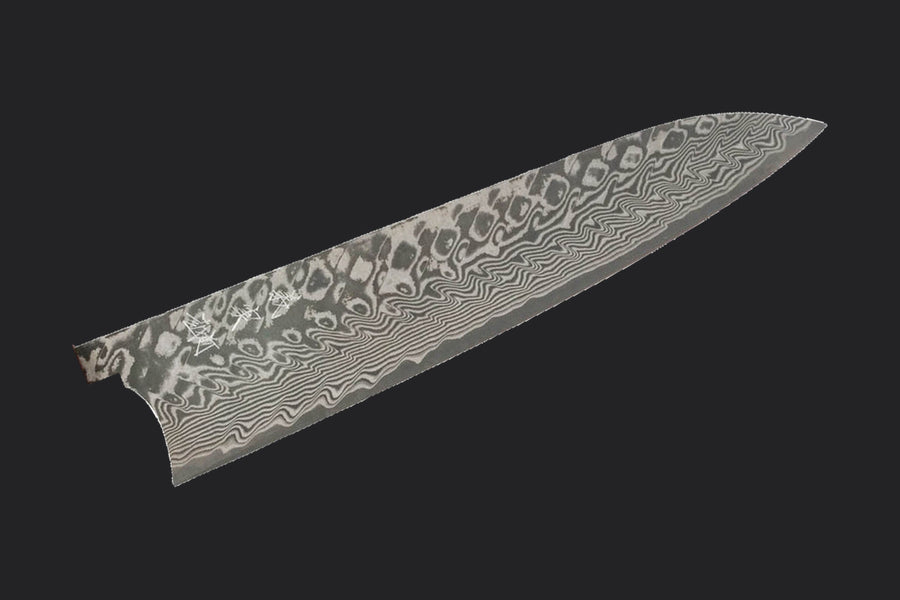
The cladding material is still the highlight of the show. On top of the layers of copper, brass and steels, Hatsukokoro applied a well controlled etching, which transfer the colour of each metal on the surface. The brass gets a deeper, gold-like look, the V-Toku core turns light grey and the copper picks up a mesmerising purple colour. It is really easy to see how this line got this name, the entire surface of the blade just shines in metallic reflection like the peacock feather.

The blade is produced in the same factory as the Hayabusa Blue 2, which inherent a pretty thin edge and a slightly convex geometry. Pairing with an acute carbon steel edge, it will perform fairly well for a knife that focuses on aesthetic. One benefit of the etching is, it creates a layer of oxidation over the carbon core steel, which acts like patina and slows down rusting, which makes the knife easier to look after as it also have stainless cladding.

Kujaku shows Hatsukokoro's continuous innovation in product design and their focus on different way of finishing their blades. As the result, this line get a very attractive and unique look. In my opinion, this is a very good option for gifting, especially to those who already have a decent Japanese knife and look for trying out carbon steel. The smooth cut and dazzling look can surely make the Kujaku a impressive gift.

Pros Cons
  • Great artistic
  • Great OOTB
  • Thin behind the edge
  • Prone to rust
Care Instruction
  1. Don't cut hard things! Japanese knives are brittle so bone hacking is a NO NO!
  2. Wash with neutral detergent after use, and wipe dry;
  3. Please don't wash knife with dishwasher, it will damage the wood handle;
  4. Be careful not to leave the knife close to a heat source for a long time;
  5. It is a lot more dangerous to cut with a blunt knife than a sharp knife!
  6. It is best to sharpen a Japanese knife regularly on a waterstone.
  7. Oil the (carbon) knife if storing for an extended period of time to prevent rust.

Hatsukokoro

Rising star of the industry

Hatsukokoro as a brand works extensively with the Japanese kitchen knife industry. Through collaboration with makers and manufacturers across the Japan, they’ve designed and created a huge collection of different knives, covering every possible price range while having a great value in many of their product lines. Their capabilities to incorporate resources have built a strong relation with knife makers, and more and more are happy to send their knives down to Amagasaki and have them delivered across the world.

“The rapidly expanding new brand in the industry based in Amagasaki, offering great varieties by working close with different makers across entire Japan to the entire globe while innovating in product design and metal fabrication.”

Est. 2019 | 令和元年
Known for Unrivalled product availability, exceptional performance at a highly competitive price.
Website handk.co Instagram @handk_official Read more about Hatsukokoro
Hatsukokoro — Hyogo
Profile: Santoku
Profile

Santoku

The Santoku knife, embodying the meaning "three uses," is a cornerstone in Japanese kitchens, adept at slicing, dicing, and mincing. Esteemed for its versatility, it features a blade length typically between 15cm and 20cm (6 to 8 inches), catering to a wide array of culinary tasks. Distinguished by its less pointy tip compared to the Gyuto, the Santoku boasts a unique profile that contributes to its functionality and popularity. Its design is tailored to provide ease and efficiency in preparation, also because of its less aggressive prrofile, making it a preferred choice for home cooks.
Composition

V-Toku 2 Element Composition

Compare with
    V-Toku 2
    1.25% 0.9% 0.6% 0.3% 0
    C Carbon 1.05%
    Primary hardening element. Raises hardness and wear resistance — but too much increases brittleness and corrosion susceptibility. As a reference: German 1.4112 (~0.5%) sits at the low end; VG-10 (~1.0%) is a common mid-range; SG2 (1.25–1.45%) and ZDP-189 (~3.0%) represent high and extreme ends respectively.
    C
    1.05%
    Cr Chromium 0.35%
    Raises corrosion resistance; 13%+ qualifies steel as stainless. Also improves hardenability and wear resistance. In kitchen use, higher chromium levels contribute to a slight drag or sticking sensation when cutting — a trade-off for the rust resistance it provides.
    Cr
    0.35%
    V Vanadium 0.2%
    Forms extremely hard carbides for superior edge retention. Also refines grain structure, improving toughness.
    V
    0.2%
    W Tungsten 1.25%
    Forms hard carbides for wear resistance and edge retention. Gives the steel hardness even at elevated temperatures.
    W
    1.25%
    Mn Manganese 0.5%
    Aids hardenability and strength. Acts as a deoxidiser during smelting. Excess can reduce toughness.
    Mn
    0.5%
    Si Silicon 0.35%
    Strengthens the steel matrix and acts as a deoxidiser. Improves hardness and resistance to oxidation.
    Si
    0.35%
    P Phosphorus 0.03%
    Impurity from the smelting process. Even small amounts cause brittleness — steelmakers keep this as low as possible.
    P
    0.03%
    S Sulfur 0.03%
    Impurity that reduces toughness and promotes brittleness. Intentionally added only in free-machining steels.
    S
    0.03%
    Ni Nickel 0.25%
    Improves toughness and ductility without sacrificing hardness. Adds a small boost to corrosion resistance.
    Ni
    0.25%
    C — Carbon Cr — Chromium V — Vanadium W — Tungsten Mn — Manganese Si — Silicon P — Phosphorus S — Sulfur Ni — Nickel
    Hardness 62–64 HRC
    555759616365+
    Steel
    V-Toku 2
    Category
    Carbon
    Manufacturer
    Takefu Special Steel, Japan 🇯🇵
    Hardness
    62–64 HRC
    Steel

    V-Toku 2

    • Manufacturer
      • Takefu Special Steel, Japan
    • Nature Carbon
    • Hardness62–64 HRC
    V-Toku 2(V特2号, V-Special 2) is Takefu Special Steel's take on the classic Hitachi Blue 2 Steel. As a alloy carbon steel, its chemical composition is very close to Blue 2 with some addition of Vanadium, combined with the higher claimed purity by Takefu, V-Toku 2 should have a slight improved wear resistance than the Blue 2.

    V-Toku 2 have excellent hardenability, which allows it to be brought up to HRC64, many makers will take advantage of the hardness to produce razor-thin blade that will slice through food extremely well. As Takefu also produce laminated billets with copper or bronze layers, V-Toku can also be seen on knives from European and American makers, which allows many chefs to benefit from the excellent cutting experience of a carbon steel knife.
    Construction: Sanmai - Stainless Damascus Clad
    Construction

    Sanmai - Stainless Damascus Clad

    Sanmai(Three-Piece) is a common construction for double bevel knives where two pieces of softer cladding steel are forgewelded to each side of a harder core steel. The harder but more brittle core steel will form the hard cutting edge after heat treating, and the softer cladding will support the core to increase the overall strength of the blade.

    Damascus Sanmai utilize damascus steel as the cladding material for the Sanmai construction, which adds aesthetic feature to the blade. On the Kitchen knives with stainless core steel, the damascus cladding will be stainless, this means they will also protect the carbon/semi-stainless core from rusting/discolouration.

    The soft cladding enables the thinning process to be a lot easier than a honyaki or monosteel construction. However, when the cladding is made of damascus, whether etched, polished or mirror polished, the thinning process will take a toll on the cladding, meaning the damascus won't look the same as when it was taken out of the box.

    Finish: Etched
    Finish

    Etched

    The etching process starts with the knife being thoroughly cleaned to remove any oils or residues. A protective mask may be applied to the areas not intended to be etched. The blade is then submerged in an acidic solution, such as ferric chloride, which reacts with the different layers of steel at varying rates. This creates a layer of dark oxide on the surface of the blade where the thickness of the oxide varies according to the reactiveness of the steel. After etching, the knife is neutralized in a baking soda solution, rinsed, and dried. The final step involves polishing the blade to highlight the etched design, enhancing both the knife's beauty and showcasing the craftsmanship of its maker.

    Handle
    Handle

    Handle Specs

    • Profile Octagonal WA
    • Material
      • Acrylic
      • Unknown

    Timble and gold flake are added in acrylic ferrule to mimic the beauty of Japanese traditional WA paper. 

    1 / 5

    You May Also Like