Crows Nest store now open from Friday to Tuesday, in store specials!

Hatsukokoro  |  SKU: HATS_VGDA_BU180

Hatsukokoro Sunaarashi VG10 Kurozome Bunka 180mm with Teak Wood Handle

Regular price $335.00
Length

Add a saya or K&S Knife Roll to receive $20 bundle discount!

Hatsukokoro Sunaarashi VG10 Kurozome
Bunka
Double Bevel
Weight 121 g | 4.3 oz
Edge Length 183 mm | 7 13/64″
Heel Height 47 mm | 1 27/32″
Width @ Heel 2.0 mm | 5/64″
Width @ Mid 1.6 mm | 1/16″
Width @ 1cm from Tip 0.8 mm | 1/32″
Steel VG10 | Stainless
Blade Construction Sanmai - Stainless Damascus Clad
Hardness (HRC) 59 - 61
Surface Finish Mirror Polish
Handle Octagonal Teak Black Ferrule
Region Hyogo
Best for
  • Collectors
  • First-timers
  • Enthusiasts
  • Free shipping for knives over AU$200 Australia wide.
  • World-wide shipping via DHL Express, 3 to 5 days.


The Hatsukokoro Sunaarashi(砂嵐, Sandstorm) VG10 Kurozome line is the brand's pitch at high end home kitchen market. The dense damascus pattern, Kurozome dyed steel and mirror polish, these features all add cost to the knife but aren't oriented towards performance. However, the knife you get is stunning to say the least. The dyed black steel is mixed into a storm of undyed silver, two contrasting tone then both reflect light with their hight glossiness. This combination is so dazzling especially when the knife is rotated under the light, it do makes you feel like you are lost in a sandstorm when inspecting this Sunaarashi line up close.

The beautiful apperance of this line doesn't hamper it from delivering great performance. With the spine of 210mm Gyuto measures at just below 2mm above the heel, these knives definitely falls under the "Laser" category. Such thin profile leads to a very thin cutting edge, and reduces resistance when cutting into thicker foods. There is one thing to be notice however, that is the mirror polish finish on this line is very smooth, it tend to creat drag/stickness when the blade is making a large area of contact with food, so if the cut is done in a slower motion, you could feel some friction as the blade is entering food like potato.

Overall the Sunaarashi line is packed with aesthetic features, as well as sharpness. Although its price is on the higher side for a VG10 core knife, when compared to some competitors like the high-end VG10 made by Mcusta Zanmai or Miyabi, these knives can be seen as an alternative option that give lightness, sharpness and a different look.

Pros Cons
  • Great artistic
  • Thin behind the edge
  • Excellent fit and finish
  • Mirror polish can be hard to maintain
  • High budget
Care Instruction
  1. Don't cut hard things! Japanese knives are brittle so bone hacking is a NO NO!
  2. Wash with neutral detergent after use, and wipe dry;
  3. Please don't wash knife with dishwasher, it will damage the wood handle;
  4. Be careful not to leave the knife close to a heat source for a long time;
  5. It is a lot more dangerous to cut with a blunt knife than a sharp knife!
  6. It is best to sharpen a Japanese knife regularly on a waterstone.

Hatsukokoro

Rising star of the industry

Hatsukokoro as a brand works extensively with the Japanese kitchen knife industry. Through collaboration with makers and manufacturers across the Japan, they’ve designed and created a huge collection of different knives, covering every possible price range while having a great value in many of their product lines. Their capabilities to incorporate resources have built a strong relation with knife makers, and more and more are happy to send their knives down to Amagasaki and have them delivered across the world.

“The rapidly expanding new brand in the industry based in Amagasaki, offering great varieties by working close with different makers across entire Japan to the entire globe while innovating in product design and metal fabrication.”

Est. 2019 | 令和元年
Known for Unrivalled product availability, exceptional performance at a highly competitive price.
Website handk.co Instagram @handk_official Read more about Hatsukokoro
Hatsukokoro — Hyogo
Profile: Bunka
Profile

Bunka

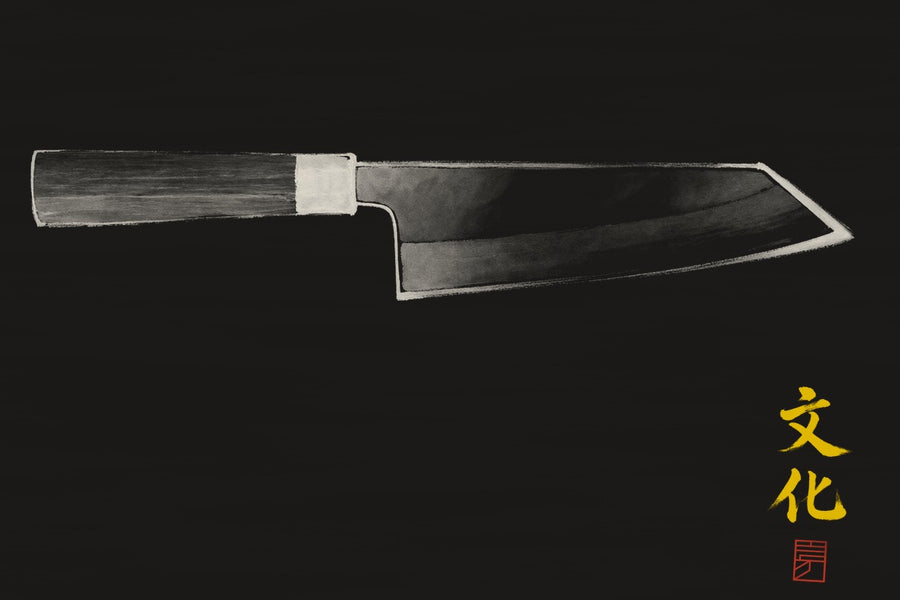
A pointier version of the Santoku. The Bunka knife features a distinctive profile with a straighter edge and a pointed tip, making it versatile for a variety of kitchen tasks. Its design is a blend of the Santoku and Gyuto knives, with a blade length typically around 165mm to 180mm. The Bunka is particularly adept at slicing, dicing, and chopping fruits, vegetables, and meats, thanks to its sharp edge and comfortable handling. The angled tip, also known as a reverse tanto, provides additional precision for intricate tasks such as julienning. With its unique shape and functionality, the Bunka stands out as a multifunctional knife in the culinary world.
Composition

VG10 Element Composition

Compare with
    VG10
    15.0% 11.3% 7.5% 3.8% 0
    C Carbon 1.0%
    Primary hardening element. Raises hardness and wear resistance — but too much increases brittleness and corrosion susceptibility. As a reference: German 1.4112 (~0.5%) sits at the low end; VG-10 (~1.0%) is a common mid-range; SG2 (1.25–1.45%) and ZDP-189 (~3.0%) represent high and extreme ends respectively.
    C
    1.0%
    Cr Chromium 15.0%
    Raises corrosion resistance; 13%+ qualifies steel as stainless. Also improves hardenability and wear resistance. In kitchen use, higher chromium levels contribute to a slight drag or sticking sensation when cutting — a trade-off for the rust resistance it provides.
    Cr
    15.0%
    V Vanadium 0.25%
    Forms extremely hard carbides for superior edge retention. Also refines grain structure, improving toughness.
    V
    0.25%
    Mo Molybdenum 1.0%
    Improves hardenability and toughness. Boosts corrosion resistance and helps the steel hold hardness under heat.
    Mo
    1.0%
    Co Cobalt 1.55%
    Allows higher hardening temperatures, increasing hardness and wear resistance. Slightly reduces toughness at high levels.
    Co
    1.55%
    C — Carbon Cr — Chromium V — Vanadium Mo — Molybdenum Co — Cobalt
    Hardness 59–61 HRC
    555759616365+
    Steel
    VG10
    Category
    Stainless
    Manufacturer
    Takefu Special Steel, Japan 🇯🇵
    Hardness
    59–61 HRC
    Steel

    VG10

    • Manufacturer
      • Takefu Special Steel, Japan
    • Nature Stainless
    • Hardness59–61 HRC
    Takefu VG10, is a high-end stainless steel celebrated for its exceptional edge retention and sharpness. It is a popular choice among Japanese kitchen knife makers and widely used in various types of knives, including kitchen knives, folders, and fixed blades.

    VG10 achieves a hardness of around 60-61 HRC, with some makers pushing it to 62 HRC, ensuring good edge holding and stain resistance. The steel's composition includes 15% chromium (Cr) for corrosion resistance, 1% molybdenum (Mo), and 1.5% cobalt (Co) for matrix strengthening, leading to high hardness and durability. The addition of vanadium (V) refines its microstructure and, along with Cr and Mo, produces hard carbides that enhance wear resistance. VG10 is easy to sharpen, has good machinability, and supports secondary hardening with high-temperature tempering, making it suitable for blades that may undergo surface coating treatments up to about 450℃. Its well-rounded attributes make VG10 steel highly versatile, performing excellently in a range of applications from kitchen and general-purpose knives to machine blades.
    Construction: Sanmai - Stainless Damascus Clad
    Construction

    Sanmai - Stainless Damascus Clad

    Sanmai(Three-Piece) is a common construction for double bevel knives where two pieces of softer cladding steel are forgewelded to each side of a harder core steel. The harder but more brittle core steel will form the hard cutting edge after heat treating, and the softer cladding will support the core to increase the overall strength of the blade.

    Damascus Sanmai utilize damascus steel as the cladding material for the Sanmai construction, which adds aesthetic feature to the blade. On the Kitchen knives with stainless core steel, the damascus cladding will be stainless, this means they will also protect the carbon/semi-stainless core from rusting/discolouration.

    The soft cladding enables the thinning process to be a lot easier than a honyaki or monosteel construction. However, when the cladding is made of damascus, whether etched, polished or mirror polished, the thinning process will take a toll on the cladding, meaning the damascus won't look the same as when it was taken out of the box.

    Finish: Mirror Polish
    Finish

    Mirror Polish

    Mirror Polish is a simplistic yet hightly demanding process, where the roughness of the metal surface is gradually removed with higher and higher grit abrasives, leading to a extremly smooth surface with only specular reflection, just like a mirror.

    The Mirror Polish can be applied to various constructions, ranging from Damascus to Honyaki. It can reveal the beautiful Hamon on the Honyaki blade, and form textural contrast on damascus. The perfect surface is highly appreciated, but it also means a lot of care must be give to avoid it being scratched.

    Handle
    Handle

    Handle Specs

    • Profile Octagonal WA
    • Material
      • Teak
      • Black Buffalo Horn

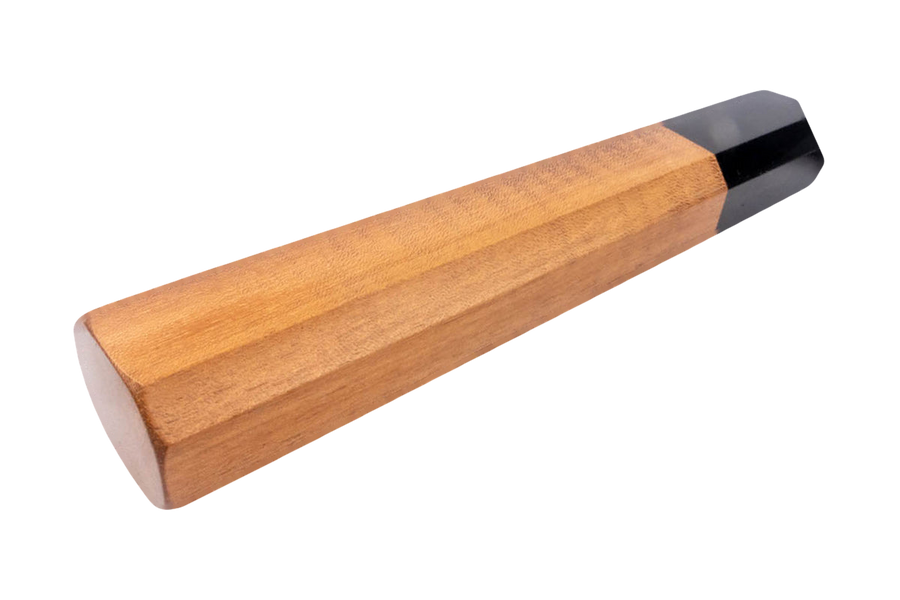
    The teak wood, known for its durability and rich grain patterns, provides a sturdy yet comfortable grip for precise handling during culinary tasks. Complemented by the sleek black horn ferrule, the handle boasts a striking contrast that adds sophistication to the overall design.

    Fashioned in an octagonal shape, the handle offers ergonomic benefits, allowing for a secure and comfortable grip from various angles. Its tapered design from bottom to top ensures a balanced feel and optimal control, promoting effortless maneuverability while slicing, chopping, or dicing ingredients.

    1 / 5

    You May Also Like