Crows Nest store now open from Friday to Tuesday, in store specials!

Shibata  |  SKU: MASA_KSAS_NA165_HIRW

Masakage Koishi AS Nakiri 165mm, Aogami Super Kurouchi Tsuchime K&S Hearted-shaped Ironwood Handle

Regular price $479.95

IMPORTANT: Carbon steel knives can rust or patina quickly if not cared for properly. They require regular cleaning, drying, and oiling. If you are unfamiliar with carbon steel maintenance, we recommend choosing a stainless steel option instead.

Add a saya or K&S Knife Roll to receive $20 bundle discount!

Masakage Koishi AS Kurouchi Tsuchime
Nakiri
Double Bevel
Weight 206 g | 7.3 oz
Edge Length 168 mm | 6 39/64″
Heel Height 60 mm | 2 23/64″
Width @ Heel 2.8 mm | 7/64″
Width @ Mid 2.0 mm | 5/64″
Width @ 1cm from Tip 1.5 mm | 1/16″
Steel Blue Super / Aogami Super | Carbon
Blade Construction Sanmai - Stainless Clad
Hardness (HRC) 62 - 65
Surface Finish Kurouchi Tsuchime
Handle Heart-shaped Ironwood Handle with Blonde Ferrule
Region Fukuyama
Best for
  • Pro chefs
  • Enthusiasts
  • Free shipping for knives over AU$200 Australia wide.
  • World-wide shipping via DHL Express, 3 to 5 days.


Koishi(小石, Pebbles)is a line that have been loved by knife enthusiasts for a long time since its creation. Forged and sharpening by Yoshimi Kato, this line still holds up to its reputation as some of the best knife produced at TAKEFU Knife Village, as well as Fukui.

The Koishi Features a beautifully done Kurouchi Tsuchime finish as well as a noticeable taper. These organic appearance not only boasts the hand forging these knives gone through in their creation, but also leads to a beautiful handling experience. The tapered spine provides the blade with rigidity, and the minimised bending can giving the user strong confidence even when cutting dense food. The extra material also shift the centre of mass into the palm, which adds some weight to the blade without making the entire knife front heavy. The subtle surface texture left from forging and heat treatment works along with the polished spine to give the user a firm grip, while the rounded corners all over the knife prevent most of the hot spots from forming.

The material choice of Koishi is Blue Super(Aogami Super) with stainless cladding, it's truly a winning formula for a good reason. The Blue Super as a carbon steel is capable of incredible sharpness, and the additional alloy element added to it also let it stands out in wear resistance compare to other typical carbon steels. With a stainless jacket cladded onto it, the attention it required is lowered without sacrificing sharpness, the super thin edge, high performance edge and polishing put on by Kato san would orchestrate the steel into an edge that flow smoothly through most of the food put in front of it.

Koishi is a signature line offered by Masakage, and it have continuously been so for many years. For anyone who is on a search for a carbon steel knife with great handling and cutting performance, the Koishi would be one of the strong contender. Very often, its beautiful finish and polished detail would help it win the heart of seasoned chef and knife lovers.

Pros Cons
  • Excellent performance
  • Thin behind the edge
  • Excellent fit and finish
  • Prone to rust
  • A little bit brittle
Care Instruction
  1. Don't cut hard things! Japanese knives are brittle so bone hacking is a NO NO!
  2. Wash with neutral detergent after use, and wipe dry;
  3. Please don't wash knife with dishwasher, it will damage the wood handle;
  4. Be careful not to leave the knife close to a heat source for a long time;
  5. It is a lot more dangerous to cut with a blunt knife than a sharp knife!
  6. It is best to sharpen a Japanese knife regularly on a waterstone.
  7. Oil the (carbon) knife if storing for an extended period of time to prevent rust.

Masakage

Masakage — Takefu's Best, Curated by Shibata

Masakage is the first original brand created by Takayuki Shibata, aimed to create knives that are all rounders with high performance, fit and finish, beauty and authentic beauty originated from the craftsmanship of masterful bladesmiths. 

The name of the Masakage Brand originated from a Warring States Samurai General Masakage Yamagata, and this name carries the hope of Shibata san of creating a versatile brand that excels in all aspects, just like how Masakage Yamagata excels in battle, strategy, diplomacy, public order, and domestic affairs. 

The knives from the Masakage Brand are all collaborations between members of the TAKEFU Knife Village and Shibata san, where the forging and heat treating are done by various big names from Echizen like Yu Kurosaki, Shiro Kamo, Yoshimi Kato or Takeshi Saji. These blades are then hand sharpened at Shibata’s workshop, where they achieve exceptional sharpness and beautiful finish.

The way that Masakage knives are done are pretty much as handcrafted as you can get while being reasonably affordable, and they do display characteristics that are unique for handcrafted knives. Commonly seen on these blades are the forge-tapered spine, elegant, organic surface finish and complex bevel geometry that offer the smoothest cut. And I have to say I really like the names that Shibata san came up with, Kiri(fog), Yuki(snow), Shimo(frost), Mizu(water), Kumo(cloud)... Each lineup gets a poetic name that triggers your imagery about nature, where that image is reflected on the appearance of the knife through a carefully designed fabrication process. As far as product design goes, Masakage is top notch in my opinion.

So Masakage is indeed doing what Shibata san want the brand to do: providing knives that are truly excellent in all aspects. They got great balance and handling, excellent sharpness and edge retention, great look and on top of that, a beautiful name to complete them as integral packages.

Read more

Masakage is the first original brand conceived by Takayuki Shibata, with the goal of producing knives that are true all-rounders: instruments that deliver high performance, impeccable fit & finish, visual beauty, and that authentic feel grounded in master bladesmith craftsmanship. The brand name itself—Masakage—is drawn from the historic figure Masakage Yamagata, a distinguished samurai general of Japan’s Warring States era. In choosing that name, Shibata-san expresses his aspiration that his knives may echo the virtues of Yamagata: excellence not just in combat, but also in strategy, diplomacy, governance, and daily life.

From a practical standpoint, every Masakage knife is the result of a close collaboration between Shibata and the artisans of TAKEFU Knife Village and Echizen’s famed forging houses. The forging and heat treatment are carried out by prominent bladesmiths of the region—names such as Yu Kurosaki, Shiro Kamo, Yoshimi Kato, or Takeshi Saji often being involved. After the forging passes, Shibata’s own workshop takes over the final sharpening, honing the blades by hand to achieve exceptional sharpness and a refined edge. The result is a blade that feels incredibly alive in use, yet is polished and finished with the precision one would expect from a high-end custom piece.

One of the particularly distinctive features of Masakage knives is their forge-tapered spine. Rather than a uniform thickness, the blade spine tapers through the forging process, reducing drag and enhancing balance. Additionally, the surface finishes often carry an elegant, somewhat organic character—textured, subtly nuanced, and resonant with a handcrafted aesthetic rather than a sterile, machine-perfect look. The bevel geometry is complex and carefully optimized: edges are shaped to glide smoothly through food, minimize resistance, and maintain cutting control. These design choices together contribute to a cutting experience that many users describe as fluid, precise, and almost effortless.

In terms of lineup naming, Masakage brings a poetic sensibility. Each series carries a nature-inspired Japanese word—Kiri (fog), Yuki (snow), Shimo (frost), Mizu (water), Kumo (cloud)—that awakens imagery of seasons, weather, and elemental phenomena. The visual appearance of each series is often subtly tuned to reflect its name: surface textures, patterning, and blade silhouette may all echo the motif (e.g. a misty, soft look for Kiri, or a crisp, cold aesthetic for Shimo). This naming philosophy reinforces that the knives are not just tools, but evocations of nature, feeling, and poetic identity.

What makes Masakage particularly compelling is that it treads the line between bespoke and attainable. The knives are as handcrafted as one would reasonably hope in small-scale production, yet their pricing remains more accessible than wholly custom blades. Because each knife is effectively a collaboration between master forgers and Shibata’s finishing, they carry many of the hallmarks of custom knives—distinctive forms, refined balance, delicate geometry—while still being viable for serious home or professional users.

Beyond pure performance, Masakage also pays close attention to aesthetic harmony and ergonomics. Handles are chosen to balance the blade, often in traditional Japanese styles (wa handles) or hybrid forms. The visual integration of blade and handle is carefully considered so that the knife feels like a seamless whole. Edge retention, sharpening ease, corrosion resistance (depending on the steel model), and maintenance are all factored into design decisions. In user reviews and knife forums, Masakage knives are praised for their balance of daily usability and artisanal character: they feel more alive than industrial kitchen knives, yet without the intimidating price tag of full bespoke works.

In sum, Masakage is very much fulfilling what Shibata-san set out to do: craft knives that excel in all dimensions—sharpness, balance, finish, beauty, and identity—while preserving a connection to true Japanese metalworking traditions and the artistry of handmade blades. They evoke nature through their names and finishes; they perform in the kitchen with grace; and they stand as a bridge between custom artistry and well-executed production.

“The all-star brand — Shibata's handpicked showcase of Takefu Knife Village's finest blacksmiths.”

Est. 2008 | 平成20年
Known for Collaborative brand featuring top Echizen blacksmiths, sharpened by Takayuki Shibata
Read more about Masakage
Masakage — Fukuyama
Profile: Nakiri
Profile

Nakiri

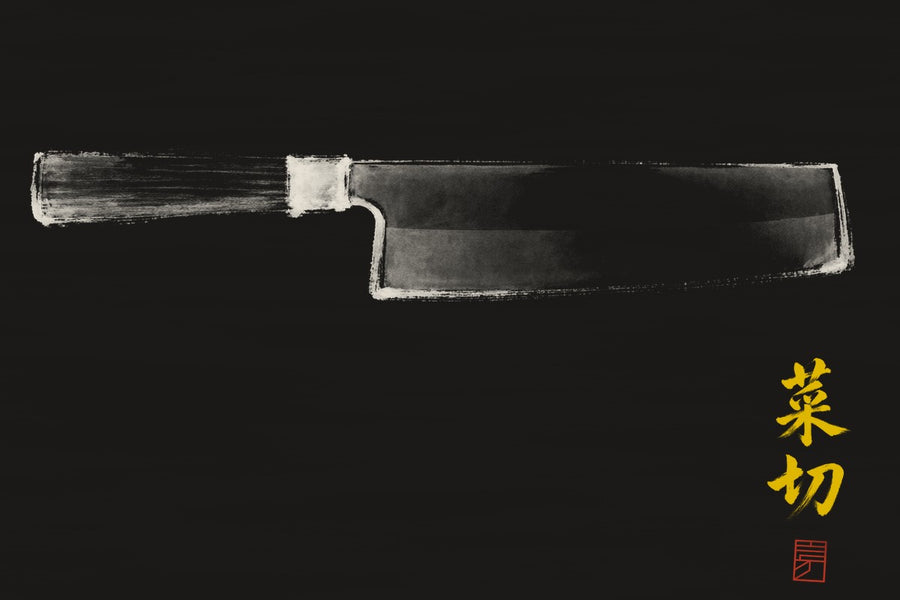
The Nakiri knife is a distinctive tool in the Japanese kitchen, resembling a slender, shorter variant of a Chinese cleaver and serving as the household counterpart to the professional-grade Usuba. It is characterized by its relatively flat edge profile, designed specifically for a chopping motion ideal for vegetable preparation. Unlike knives intended for slicing or sawing motions, the Nakiri's design emphasizes straight, clean cuts through vegetables without the need for pushing or rocking. Its blade is notably thin, underscoring its specialization for tasks that do not involve contact with bones, even small ones. This specialization makes the Nakiri an indispensable tool for those seeking precision and ease in vegetable preparation.
Composition

Blue Super / Aogami Super Element Composition

Compare with
    Blue Super / Aogami Super
    2.0% 1.5% 1.0% 0.5% 0
    C Carbon 1.4%
    Primary hardening element. Raises hardness and wear resistance — but too much increases brittleness and corrosion susceptibility. As a reference: German 1.4112 (~0.5%) sits at the low end; VG-10 (~1.0%) is a common mid-range; SG2 (1.25–1.45%) and ZDP-189 (~3.0%) represent high and extreme ends respectively.
    C
    1.4%
    Cr Chromium 0.3%
    Raises corrosion resistance; 13%+ qualifies steel as stainless. Also improves hardenability and wear resistance. In kitchen use, higher chromium levels contribute to a slight drag or sticking sensation when cutting — a trade-off for the rust resistance it provides.
    Cr
    0.3%
    W Tungsten 2.0%
    Forms hard carbides for wear resistance and edge retention. Gives the steel hardness even at elevated temperatures.
    W
    2.0%
    Mn Manganese 0.2%
    Aids hardenability and strength. Acts as a deoxidiser during smelting. Excess can reduce toughness.
    Mn
    0.2%
    Si Silicon 0.1%
    Strengthens the steel matrix and acts as a deoxidiser. Improves hardness and resistance to oxidation.
    Si
    0.1%
    P Phosphorus 0.025%
    Impurity from the smelting process. Even small amounts cause brittleness — steelmakers keep this as low as possible.
    P
    0.025%
    S Sulfur 0.004%
    Impurity that reduces toughness and promotes brittleness. Intentionally added only in free-machining steels.
    S
    0.004%
    C — Carbon Cr — Chromium W — Tungsten Mn — Manganese Si — Silicon P — Phosphorus S — Sulfur
    Hardness 62–65 HRC
    555759616365+
    Steel
    Blue Super / Aogami Super
    Category
    Carbon
    Manufacturer
    Hitachi Special Steel, Japan 🇯🇵
    Hardness
    62–65 HRC
    Steel

    Blue Super / Aogami Super

    • Manufacturer
      • Hitachi Special Steel, Japan
    • Nature Carbon
    • Hardness62–65 HRC
    Aogami Super steel, also known as Blue Super Steel, is highly esteemed among Japanese carbon steels for its exceptional qualities. Produced by Hitachi Metals Ltd., this steel surpasses Blue Steel No.1 in its composition, featuring higher amounts of carbon, chromium, and tungsten, with the addition of molybdenum. Aogami Super is celebrated for its remarkable edge sharpness and superior edge retention capabilities. It can achieve high levels of hardness without becoming brittle, a characteristic that sets it apart and endears it to knife enthusiasts worldwide. The steel's enhanced carbon content enables it to maintain sharpness for extended periods, while the added chromium aids in rust resistance. A touch of vanadium increases its toughness, making it less prone to chipping. These attributes make Aogami Super one of the most revered high carbon steels globally, often described as a knife nerd's dream for its balance of hardness, durability, and maintenance ease.
    Construction: Sanmai - Stainless Clad
    Construction

    Sanmai - Stainless Clad

    Sanmai(Three-Piece) is a common construction for double bevel knives where two pieces of softer cladding steel are forgewelded to each side of a harder core steel. The harder but more brittle core steel will form the hard cutting edge after heat treating, and the softer cladding will support the core to increase the overall strength of the blade.

    The soft cladding enables the thinning process to be a lot easier than a honyaki or monosteel construction. And in the case where the cladding steel are stainless in nature, it can offer protection for the carbon or semi-stainless cores against rusting and discoluoring.

    Finish: Kurouchi Tsuchime
    Finish

    Kurouchi Tsuchime

    The Kurouch Tsuchime is a combination of the raw, organic black finish and the characterful hammered Tsuchime finish. It is commonly seen as the Kurouchi finish will keep the original black scale of the billet unpolished after forging, the texture from the forging process will be also kept, allowing all kinds of patterns and indentations to be introduced to the blade. As a combination of Kurouchi and Tsuchime, this finish also inherents their benifits: reduce drag, help with food release and protect the steel from rusting. Over all Kurouchi Tsuchime is a practical and esthetically unique finish.

    Handle
    Handle

    Handle Specs

    • Profile Heart Shape WA
    • Material
      • Desert Ironwood

    The heart-shaped desert ironwood handle on Japanese kitchen knives offers ergonomic advantages, providing a comfortable grip that reduces fatigue during prolonged use. Its design conforms naturally to the hand, enhancing control and maneuverability for precise cutting tasks. This handle shape also promotes balanced weight distribution between the blade and handle, improving overall control and reducing strain on the wrist and arm.

    Beyond functionality, the Desert Ironwood's luxurious appearance adds aesthetic appeal to the knife, elevating its visual appeal in the kitchen. Whether it's a versatile Santoku knife, a multipurpose Gyuto, a specialized Deba for fish, or a precise Yanagiba for sashimi, the heart-shaped Desert Ironwood handle enhances both the performance and the beauty of Japanese kitchen knives, making them indispensable tools for culinary enthusiasts and professionals alike.

    1 / 5

    You May Also Like