Crows Nest store now open from Friday to Tuesday, 10am till 6pm.

Hatsukokoro  |  SKU: HT-YOSHIKUW2-HS150-EB

Yoshikane White 2 KU Nashiji Honesuki 150mm Stainless Clad Ebony by Hatsukokoro

Regular price $529.95

IMPORTANT: Carbon steel knives can rust or patina quickly if not cared for properly. They require regular cleaning, drying, and oiling. If you are unfamiliar with carbon steel maintenance, we recommend choosing a stainless steel option instead.

Availability

  • St Peters
    2 Bishop St Unit 2 St Peters NSW 2044
  • Crows Nest
    107 West St, Crows Nest NSW 2065
    Pickup only
Detailed Specifications
Line Hatsukokoro By Yoshikane KU White 2 Nashiji
Profile Honesuki / Boning, Garasuki
Bevel Type Double Bevel
Weight 135 g | 4.8 oz
Edge Length 157 mm | 6 3/16″
Heel Height 45 mm | 1 49/64″
Width @ Heel 4.0 mm | 5/32″
Width @ Mid 2.6 mm | 7/64″
Width @ 1cm from Tip 1.9 mm | 5/64″
Steel White 2 / Shirogami #2 | Carbon
Blade Construction Sanmai - Stainless Clad
Hardness (HRC) 60 - 64
Surface Finish Nashiji
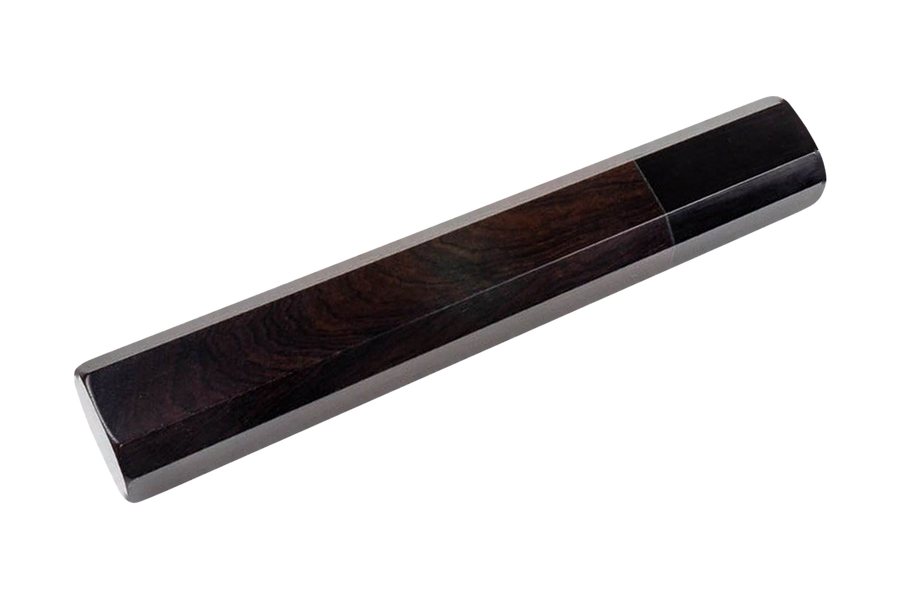
Handle Octagonal Ebony with Black Horn Ferrule
Region Sanjo
Best for
  • Pro chefs
  • Students
  • Enthusiasts
  • Free shipping for knives over AU$200 Australia wide.
  • World-wide shipping via DHL Express, 3 to 5 days.


The Yoshikane KU Nashiji line is for those who believe a knife’s only job is to cut flawlessly. This is where legendary Yoshikane geometry meets a darker, more rustic attitude, all while hiding its high-maintenance heart under easy-care stainless cladding.

At its core is Hitachi White #2 steel, a pure carbon steel revered for its ability to take on a scary-sharp, refined edge that harder, chromium-heavy steels can’t match. That legendary sharpness is unleashed by Yoshikane’s masterful thin, convex grind and significant blade taper, which slices through ingredients with minimal resistance and virtually no wedging—even in dense potatoes.

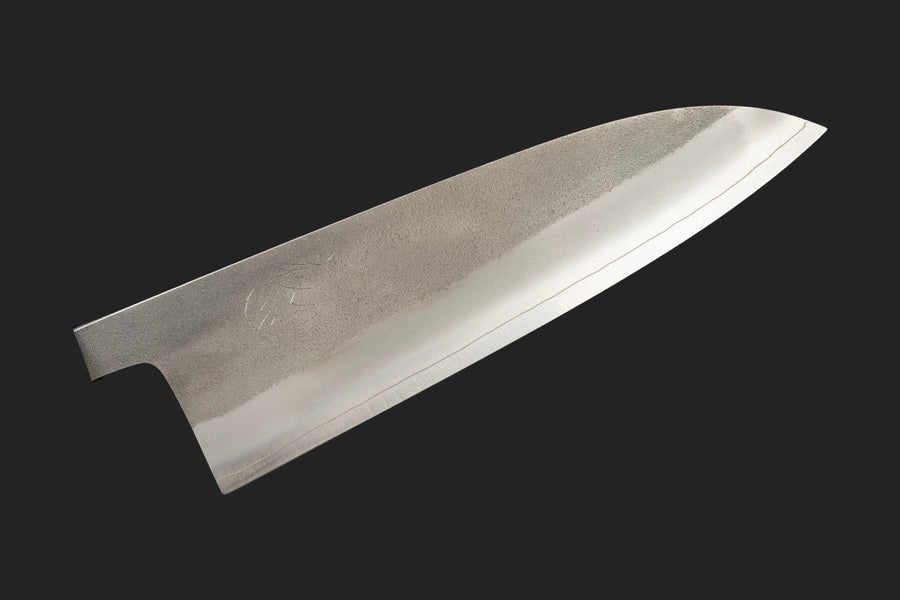
The difference is in the finish. The nashiji ("pear skin") texture is left darker and more subdued under a rugged Kurouchi (KU) coating, offering a distinctly matte, utilitarian beauty that’s as functional as it is striking.

You still get Yoshikane’s obsessive fit and finish: a highly polished spine and choil for comfort, and a stunning contrast between the rough finish and the razor-sharp, polished edge.

It’s a no-fuss, high-performance tool. You get the soul of a carbon steel laser with the stainless cladding’s peace of mind. For pure cutting performance, it remains one of the best values you can find.

Pros Cons
  • Excellent performance
  • Great for professionals
  • Thin behind the edge
  • High budget
  • Prone to rust
Care Instruction
  1. Don't cut hard things! Japanese knives are brittle so bone hacking is a NO NO!
  2. Wash with neutral detergent after use, and wipe dry;
  3. Please don't wash knife with dishwasher, it will damage the wood handle;
  4. Be careful not to leave the knife close to a heat source for a long time;
  5. It is a lot more dangerous to cut with a blunt knife than a sharp knife!
  6. It is best to sharpen a Japanese knife regularly on a waterstone.
  7. Oil the (carbon) knife if storing for an extended period of time to prevent rust.

Yoshikane Hamono

Traditional Sanjo Knife Maker.

Yoshikane is a boutique knife maker based in Sanjo, Niigata. Founded in 1919 (大正8年),it is one of the most established top quality kitchen knife manufacturers in the region. Many new generation blacksmith in Sanjo took has apprenticeship experience at this knife workshop. 

Headmaster Yamamoto-san believes, “while many things change rapidly nowadays, there are ideas and believes that never change. Everyday I make sure the meaning of these words are forged into knife making”. And indeed because of this firm believe, this workshop produces some of the highest quality kitchen knives with superb fit and finish. The workshop is also very famous for its heat treatment of White 2 and the use of semi-stainless SKD steel. 

“Top performance Japanese kitchen knives from Sanjo, Niigata, renowned for exceptional grind quality and masterful heat treatment of White #2 and SKD semi-stainless steels.”

Est. 1919 | 大正8年
Known for Ultra thin Sanjo grinds, master of Sanjo blacksmith.
Website yoshikanehamono.com Read more about Yoshikane Hamono
Yoshikane Hamono — Sanjo
Profile: Honesuki
Profile

Honesuki

Boning, Garasuki

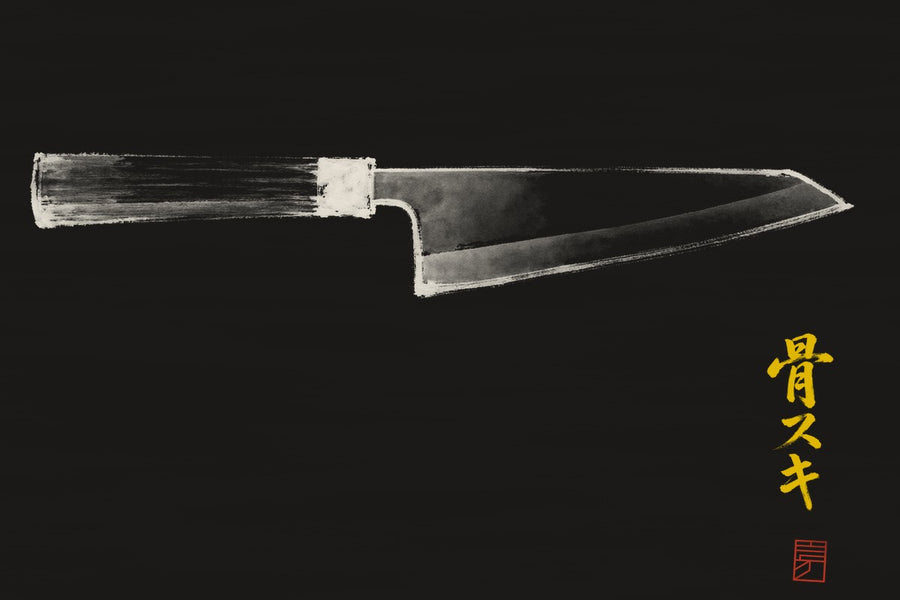
The Honesuki is a specialized Japanese kitchen knife, designed primarily for boning and preparing poultry. Its unique profile features a triangular shape with a pointed tip, combines with the strength gained through its thickness, make it ideal for manoeuvring around bones, punctures tough tissues and cut through joints. Unlike Western boning knives, the Honesuki's stiff and broad blade excels in precision work rather than relying on a flexible blade. It often comes with a single bevel design, although double-bevel variants are also available for more versatility. Preferred for its agility and precision, the Honesuki is a favorite among chefs for deboning and preparing meat with minimal waste.
Composition

White 2 / Shirogami #2 Element Composition

Compare with
    White 2 / Shirogami #2
    1.05% 0.8% 0.5% 0.3% 0
    C Carbon 1.05%
    Primary hardening element. Raises hardness and wear resistance — but too much increases brittleness and corrosion susceptibility. As a reference: German 1.4112 (~0.5%) sits at the low end; VG-10 (~1.0%) is a common mid-range; SG2 (1.25–1.45%) and ZDP-189 (~3.0%) represent high and extreme ends respectively.
    C
    1.05%
    Mn Manganese 0.2%
    Aids hardenability and strength. Acts as a deoxidiser during smelting. Excess can reduce toughness.
    Mn
    0.2%
    Si Silicon 0.1%
    Strengthens the steel matrix and acts as a deoxidiser. Improves hardness and resistance to oxidation.
    Si
    0.1%
    P Phosphorus 0.025%
    Impurity from the smelting process. Even small amounts cause brittleness — steelmakers keep this as low as possible.
    P
    0.025%
    S Sulfur 0.004%
    Impurity that reduces toughness and promotes brittleness. Intentionally added only in free-machining steels.
    S
    0.004%
    C — Carbon Mn — Manganese Si — Silicon P — Phosphorus S — Sulfur
    Hardness 60–64 HRC
    555759616365+
    Steel
    White 2 / Shirogami #2
    Category
    Carbon
    Manufacturer
    Hitachi Special Steel, Japan 🇯🇵
    Hardness
    60–64 HRC
    Steel

    White 2 / Shirogami #2

    • Manufacturer
      • Hitachi Special Steel, Japan
    • Nature Carbon
    • Hardness60–64 HRC
    White Steel No.2, also known as Shirogami #2 or White Paper #2, is long regarded as the go-to choice for crafting high-grade Japanese kitchen knives. This steel is celebrated for its capacity to be fashioned into knives that exhibit a sharp cutting edge, moderate tenacity, and long-lasting sharpness, alongside being notably easy to sharpen. While it possesses a slightly lower carbon content (C: 1%) compared to White Steel No.1 (C: 1.3%), it still requires a high level of craftsmanship to manipulate effectively. The expertise of a skilled blacksmith is crucial in transforming this material into a premium quality kitchen knife. Despite its excellent qualities, White Steel No.2 is known to be very reactive; hence, knives made from this steel demand meticulous care, including immediate wiping and drying after use, to prevent corrosion.

    Sanjo and Sakai are known to widely utilise Shirogami #2 in their mainstream kitchen knives.
    Construction: Sanmai - Stainless Clad
    Construction

    Sanmai - Stainless Clad

    Sanmai(Three-Piece) is a common construction for double bevel knives where two pieces of softer cladding steel are forgewelded to each side of a harder core steel. The harder but more brittle core steel will form the hard cutting edge after heat treating, and the softer cladding will support the core to increase the overall strength of the blade.

    The soft cladding enables the thinning process to be a lot easier than a honyaki or monosteel construction. And in the case where the cladding steel are stainless in nature, it can offer protection for the carbon or semi-stainless cores against rusting and discoluoring.

    Finish: Nashiji
    Finish

    Nashiji

    The "nashiji finish" on Japanese kitchen knives refers to a unique, textured surface finish that resembles the skin of an Asian pear, which is known as "nashi" in Japanese. This finish is achieved through a specific hammering and polishing technique, giving the knife blade a distinct, matte appearance with a slightly uneven, tactile surface. Beyond its aesthetic appeal, the nashiji finish also provides practical benefits. It helps to reduce food sticking to the blade by creating tiny air pockets between the food and the steel. This finish is commonly found on traditional Japanese knives, such as santokus and nakiris, and is highly valued for both its functional and visual characteristics, enhancing the overall culinary experience.

    Handle
    Handle

    Handle Specs

    • Profile Octagonal WA
    • Material
      • Ebony
      • Black Buffalo Horn

    Standard octagonal section and profile handle made with black ebony, with a black buffalo horn ferrule.

    1 / 5

    You May Also Like