

Sakai Takayuki Grand Chef SP Petty 150mm
Sakai Takayuki Grand Chef SP Petty 150mm is backordered and will ship as soon as it is back in stock.
Availability
Delivery unavailable for this item. Available for in-store pickup only.
-
St Peters, NSW —2 Bishop St, Unit 2, St Peters NSW 2044
-
Crows Nest, NSW —107 West St, Shop 1, Crows Nest NSW 2065Pickup only
-
Prahran, VIC —180 Commercial Road, Shop 1, Prahran VIC 3181Pickup only
Detailed Specifications
| Profile | Petty / Utility, Paring |
| Bevel Type | Double Bevel |
| Weight | 80 g 2.82 oz |
| Edge Length | 150 mm .5.91 inch |
| Heel Height | 26 mm .1.02 inch |
| Width @ Spine | 1.8 mm 0.07 inch |
| Width @ Mid | 1.4 mm 0.06 inch |
| Width @ 1cm from Tip | 0.6 mm 0.02 inch |
| Steel | Swedish Steel | Stainless |
| Hardness (HRC) | 58 - 60 |
| Handle | Western Pakka Wood with Bolster |
The Sakai Takayuki Grand Chef SP Petty 150mm is a double-bevel utility knife featuring Swedish stainless steel, best fit for users requiring a precise tool for peeling, trimming, and detailed preparation tasks. This 150mm blade serves as a smaller Japanese utility knife designed specifically for intricate work such as deveining shrimp, cutting garnishes, and slicing fruits or vegetables. Its profile supports both in-hand peeling and general-purpose kitchen use, functioning effectively where detailed control is necessary.
Constructed from Swedish steel manufactured by Sandvik or Uddeholm, the blade measures 1.8mm at the heel and tapers to 0.6mm at the tip with a 26mm heel height. This stainless steel contains approximately 0.65% carbon and 13% chromium, achieving a hardness between 58 and 60 HRC. The knife weighs 80g and features a double bevel geometry suitable for precision cutting. The slim profile enhances functionality for detailed tasks while maintaining the characteristics expected of Swedish stainless steel in a compact utility format.
- Don't cut hard things! Japanese knives are brittle so bone hacking is a NO NO!
- Wash with neutral detergent after use, and wipe dry;
- Please don't wash knife with dishwasher, it will damage the wood handle;
- Be careful not to leave the knife close to a heat source for a long time;
- It is a lot more dangerous to cut with a blunt knife than a sharp knife!
- It is best to sharpen a Japanese knife regularly on a waterstone.
-
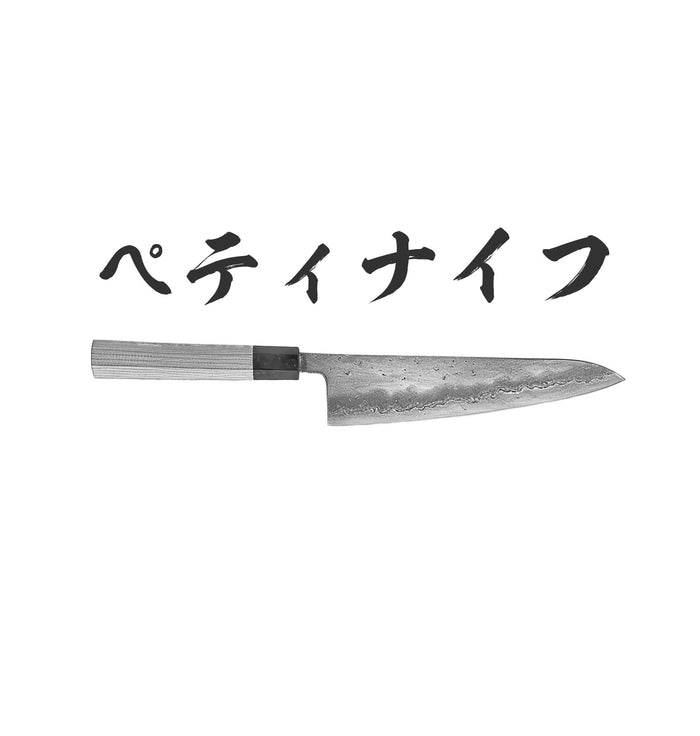
Profile: Petty
Utility, Paring
Slide for more >>
-

Steel: Swedish Steel
Manufacturer:
Nature: Stainless
Hardness: 58- 60
<< Slide for more >>
-
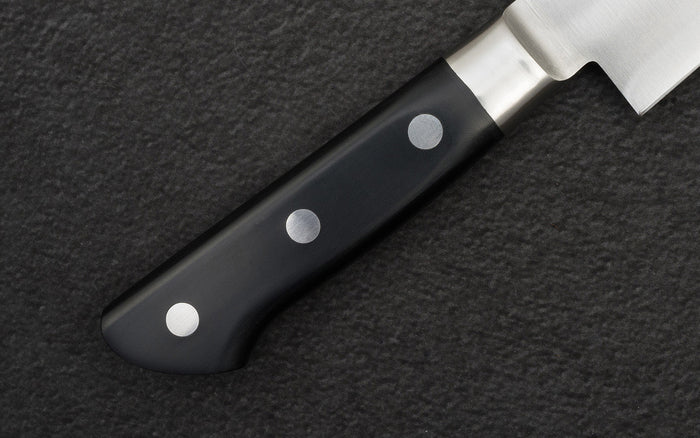
Handle Specs
Profile: Western with bolster
Material:
<< Slide for more