Crows Nest store now open from Friday to Tuesday, in store specials!

Myojin Riki  |  SKU: MJ-COSP-BU180

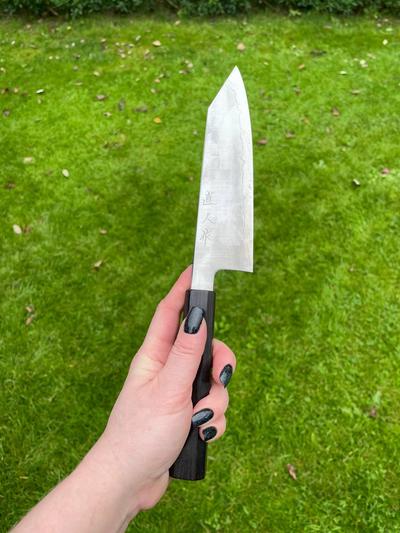
Myojin Cobalt Special COSP Bunka 180mm Ebony Handle

Regular price $349.95

Pickup currently unavailable at Crows Nest

Add a saya or K&S Knife Roll to receive $20 bundle discount!

Set currency to AUD to view correct price matching.
K&S Price: AU$349.95*inc. tax,vs:
Store CE AU $359.0 -2.87%
Store K AU $403.57 -15.64%

*For overseas buyers you pay no GST (10%) and low shipping rate.
Last Update:2026-04-23T17:07:52Z

Myojin Cobalt Special COSP
Bunka
Double Bevel
Weight 131 g | 4.6 oz
Edge Length 169 mm | 6 21/32″
Heel Height 48 mm | 1 57/64″
Width @ Heel 2.1 mm | 5/64″
Width @ Mid 1.9 mm | 5/64″
Width @ 1cm from Tip 0.8 mm | 1/32″
Steel COSP (Cobalt Special) | Stainless
Blade Construction Sanmai - Stainless Clad
Hardness (HRC) 60 - 62
Surface Finish Ukiba
Handle Octagonal Black Chacate
Region Tosa
Best for
  • First-timers
  • Pro chefs
  • Free shipping for knives over AU$200 Australia wide.
  • World-wide shipping via DHL Express, 3 to 5 days.


The Cobalt Special (COSP) knives from Myojin Riki feature blades crafted from Cobalt Special steel, a high-end Japanese stainless steel known for superior edge retention, sharpness, and corrosion resistance. Enriched with carbon and chromium, it offers excellent durability. The addition of cobalt, molybdenum, and vanadium enhances its hardness and wear resistance, making it ideal for everyday use.

Pros Cons
  • Easy to look after
  • Excellent fit and finish
  • Thin behind the edge
  • More sharpening needed
Care Instruction
  1. Don't cut hard things! Japanese knives are brittle so bone hacking is a NO NO!
  2. Wash with neutral detergent after use, and wipe dry;
  3. Please don't wash knife with dishwasher, it will damage the wood handle;
  4. Be careful not to leave the knife close to a heat source for a long time;
  5. It is a lot more dangerous to cut with a blunt knife than a sharp knife!
  6. It is best to sharpen a Japanese knife regularly on a waterstone.

Myojin Riki

Myojin Riki Seisakusho — Tosa's Sharpening Prodigy

The Myojin Riki Manufacturing, established by a founder who mastered his skills in Osaka, the heartland of blade-making, has been operational for over 80 years. Specializing in knives made from steel and iron, they've recently focused on stainless steel knives, valued for their light weight, resistance to rust, and exceptional sharpness. These knives are popular among both professionals and general consumers, partly due to their application of the "stacked steel pattern" traditionally found in swords. The second generation continues to innovate, customizing products to meet users' needs, while also contributing to cultural preservation through their involvement with local traditional performances and blade repairs.

Naohito Myojin, the second generation craftsman of Myojin Riki, has dedicated himself to continuing the legacy of his predecessor's craftsmanship in knife making. Focused on innovation while preserving traditional techniques, Naohito has made a significant mark in the field by customizing knives that not only meet the practical needs of users but also contribute to the cultural heritage through his involvement in local traditions and blade restoration efforts. His work reflects a deep commitment to quality, functionality, and the preservation of the artistry involved in Japanese knife making.

“From Sakai-trained roots in Tosa — a father-son forge where the grind is everything.”

Est. 1950 | 昭和25年
Known for Exceptional grinding and sharpening, tanryusen (metal flow) finish
Instagram @tetsujin_labo Read more about Myojin Riki
Myojin Riki — Tosa
Profile: Bunka
Profile

Bunka

A pointier version of the Santoku. The Bunka knife features a distinctive profile with a straighter edge and a pointed tip, making it versatile for a variety of kitchen tasks. Its design is a blend of the Santoku and K-tip Gyuto knives, with a blade length typically around 165mm to 180mm. The Bunka is particularly adept at slicing, dicing, and chopping fruits, vegetables, and meats, thanks to the precision and control enabled by its length and flat edge profile. The angled tip, also known as a reverse tanto, provides additional precision for intricate tasks such as julienning. With its unique shape and functionality, the Bunka stands out as a multifunctional knife in the culinary world.
Composition

COSP (Cobalt Special) Element Composition

Compare with
    COSP (Cobalt Special)
    16.0% 12.0% 8.0% 4.0% 0
    C Carbon 1.05%
    Primary hardening element. Raises hardness and wear resistance — but too much increases brittleness and corrosion susceptibility. As a reference: German 1.4112 (~0.5%) sits at the low end; VG-10 (~1.0%) is a common mid-range; SG2 (1.25–1.45%) and ZDP-189 (~3.0%) represent high and extreme ends respectively.
    C
    1.05%
    Cr Chromium 16.0%
    Raises corrosion resistance; 13%+ qualifies steel as stainless. Also improves hardenability and wear resistance. In kitchen use, higher chromium levels contribute to a slight drag or sticking sensation when cutting — a trade-off for the rust resistance it provides.
    Cr
    16.0%
    V Vanadium 0.25%
    Forms extremely hard carbides for superior edge retention. Also refines grain structure, improving toughness.
    V
    0.25%
    Mo Molybdenum 1.5%
    Improves hardenability and toughness. Boosts corrosion resistance and helps the steel hold hardness under heat.
    Mo
    1.5%
    W Tungsten 0.25%
    Forms hard carbides for wear resistance and edge retention. Gives the steel hardness even at elevated temperatures.
    W
    0.25%
    Co Cobalt 2.5%
    Allows higher hardening temperatures, increasing hardness and wear resistance. Slightly reduces toughness at high levels.
    Co
    2.5%
    C — Carbon Cr — Chromium V — Vanadium Mo — Molybdenum W — Tungsten Co — Cobalt
    Hardness 60–62 HRC
    555759616365+
    Steel
    COSP (Cobalt Special)
    Category
    Stainless
    Manufacturer
    Takefu Special Steel, Japan 🇯🇵
    Hardness
    60–62 HRC
    Steel

    COSP (Cobalt Special)

    • Manufacturer
      • Takefu Special Steel, Japan
    • Nature Stainless
    • Hardness60–62 HRC
    Takefu Special Steel's Cobalt Special steel, often referred to as Cobalt Steel, is a premium high-performance steel known for its exceptional edge retention and hardness. This steel incorporates a significant amount of cobalt in its composition, enhancing its wear resistance and strength. The addition of cobalt, along with other elements like carbon, chromium, and molybdenum, allows the steel to achieve a high level of hardness without compromising its toughness. Cobalt Special steel is designed to maintain a sharp edge for extended periods, even under rigorous use, making it highly valued for crafting high-end kitchen knives and cutting tools.
    Makers such as Mojin and Kurosaki have some excellent COSP offerings.
    Construction: Sanmai - Stainless Clad
    Construction

    Sanmai - Stainless Clad

    Sanmai(Three-Piece) is a common construction for double bevel knives where two pieces of softer cladding steel are forgewelded to each side of a harder core steel. The harder but more brittle core steel will form the hard cutting edge after heat treating, and the softer cladding will support the core to increase the overall strength of the blade.

    The soft cladding enables the thinning process to be a lot easier than a honyaki or monosteel construction. And in the case where the cladding steel are stainless in nature, it can offer protection for the carbon or semi-stainless cores against rusting and discoluoring.

    Finish: Ukiba
    Finish

    Ukiba

    Ukiba(浮き刃, floating edge) finish describes a very specific look where the blade is finished mostly in Migaki/brushed finish, and a band of hazy matt finish is applied right above the cladding line using sandblasting. The shiny core steel contrasts with the matt band on the cladding and highlight the edge. As the cladding lines are usually wavy, the edge would looks like it's floating above a cloud, which grant this finish the name Ukiba.

    Handle
    Handle

    Handle Specs

    • Profile Octagonal WA
    • Material
      • Black Chacate

    Black Chacate is a highly valued timber known for its deep, rich brown to almost black coloration, fine texture, and exceptional durability. It polishes well, offering an exquisite finish that highlights its subtle, elegant grain patterns. This wood is often used in fine woodworking projects, including luxury furniture, decorative items, and high-end knife handles.

    An octagonal wa handle made from Black Chacate wood would exhibit a sleek, geometric shape that fits comfortably in the hand, enhancing the user's grip and control. The deep hues and natural luster of Black Chacate add a touch of sophistication and unparalleled beauty to the handle, making it not only a functional component of a kitchen knife but also a piece of art. The durability and stability of Black Chacate ensure that the handle withstands the rigors of kitchen use while maintaining its aesthetic appeal over time.

    1 / 5

    You May Also Like